If you were about to buy a Woodpeckers precision square, the alternative for most shops is the iGaging combination square set. It is for anyone who needs one layout tool rather than a collection: 6 in. and 12 in. blades, 4R graduations and hardened steel, so it marks a 90, sets a 45, measures a depth and gauges a rabbet — none of which a fixed square does. The budget pick is the Swanson S0101 speed square, which is the cheapest genuinely useful square you can own and doubles as a saw fence for a dead-square crosscut.
If what you want is an unarguable reference rather than a cheaper one, skip to the Starrett. Prices beside each pick come from our live price layer rather than from this article, last checked November 23, 2026.
What a Woodpeckers tool actually sells
Woodpeckers builds CNC-machined aluminum layout tools and rates them tightly: the 6 in. Precision Woodworking Square is published as square to within a claimed 0.001 in. over its length, with an offset shoulder that lets it stand on the edge of a board on its own and laser-engraved scales. It does not rust, it is light, and it is a fixed square — one angle, no moving parts, nothing to drift.
That is three separate products bundled into one price, and the alternatives below each replace one of them.
One: a reference you never doubt. The single most useful property of a good square is that when the joint looks wrong you blame the joint, not the square. That is worth real money, once.
Two: a tool that stands up on the work. The offset shoulder is a genuine design feature. It means you can set the square against a shoulder or a saw cut and look at the gap without a third hand holding the tool.
Three: a tool that will not corrode. Machined aluminum shrugs off a damp garage. A hardened steel square wants a wipe of oil, and a neglected one spots.
What a fixed square does not do is measure anything, set an angle other than 90, or gauge a depth. If you own one layout tool, that is a serious limitation, and it is the reason the first alternative here is not a square at all but a combination square.
Route one: buy a combination square instead, and buy a good one
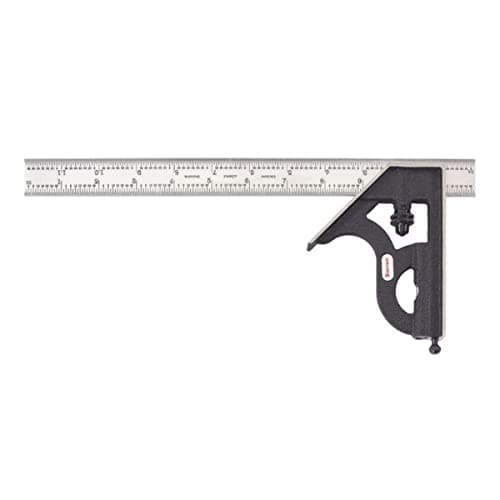
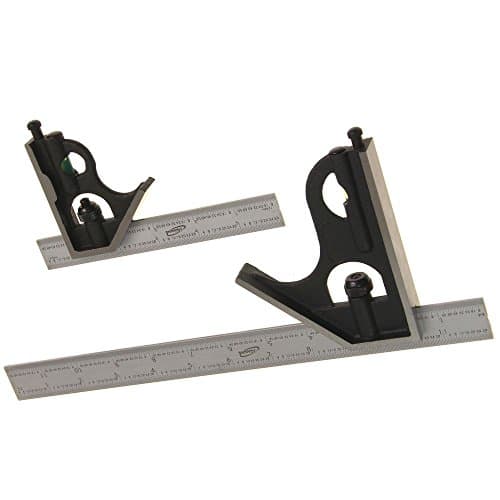
A combination square is a hardened steel rule that slides through a cast head, with a 90 and a 45 face, a locking bolt, usually a scriber and often a small level. It marks square lines, it marks mitres, it sets a depth, it gauges a tenon shoulder, it measures, and it checks a machine. For a first shop it is unambiguously the layout tool to own before any other.
The iGaging combination square setis the value answer: 6 in. and 12 in. blades with 4R graduations — which means fractions in 1/64, 1/32, 1/16 and 1/8, the graduation set furniture work is laid out in — in hardened steel, for a fraction of a premium square. Check it for square when it arrives, as you should with any budget square: hold it against a known-straight edge, draw a line, flip the head and draw again, and look at whether the two lines agree.
The Starrett C11H-12-4Ris the other end of that route and the honest answer to "I want a reference I never doubt." A hardened, photo-engraved blade in a ground cast-iron head, a reversible lock bolt, a scriber and a real spirit level. It is ground square and true out of the box and it is the tool every other square in your shop gets checked against for the rest of your working life. It costs more than the Woodpeckers square it replaces and does strictly more, which is a sentence worth re-reading if you were about to buy on brand.
Our woodworking squares roundup ranks that whole field including the Woodpeckers original, and measuring and marking tools covers the full layout kit rather than just the squares.
Route two: machine setup, where small fixed squares beat everything
There is one job a combination square is clumsy at and a Woodpeckers square is expensive at: checking a table saw blade to the table, a fence to a mitre slot, a drill press table to the bit, or an assembled carcase for square.
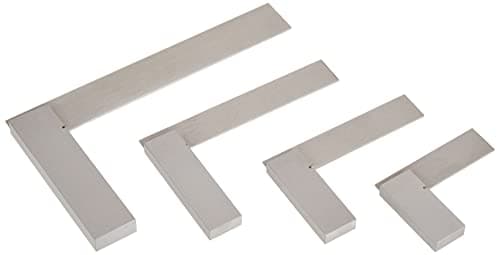
The Woodstock D4089 machinist square set is the right tool and it costs less than a single premium square. Four hardened steel squares at 2, 3, 4 and 6 in., rated by the maker as square to a claimed 0.0006 in., with a relieved inside notch so dust and chips do not stop the square seating flush against the work. Four sizes matter because the useful square for a blade-to-table check is a small one and the useful square for a cabinet corner is not.
They do nothing except 90 degrees. They do not measure, mark or set an angle, and small steel squares want a wipe of oil in a damp shop. For a shop that tunes its machines rather than trusting them, they are the highest-value layout purchase on this page.
Route three: the cheap tools that do most of the daily work
Two tools here cost almost nothing and get used more than anything else in the drawer.
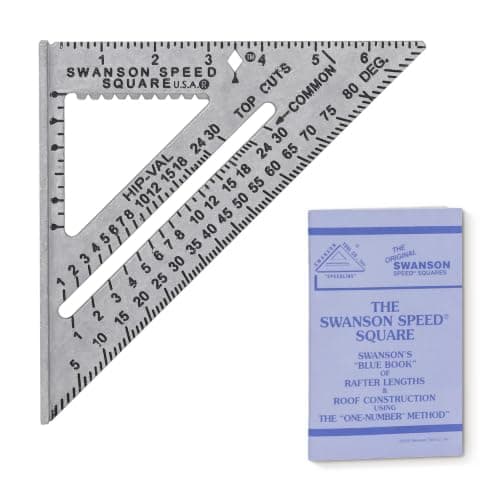
The Swanson S0101 speed squareis a cast aluminum triangle with a fence on one edge. It is not a fine-joinery tool — the body is thick and the graduations are framing graduations — and it is unbeatable at two jobs: marking a fast 45 or 90 across a board, and acting as a fence for a circular saw to run against for a square crosscut. That second use alone justifies owning one, and it is relevant to anyone breaking down sheet goods with a circular saw.
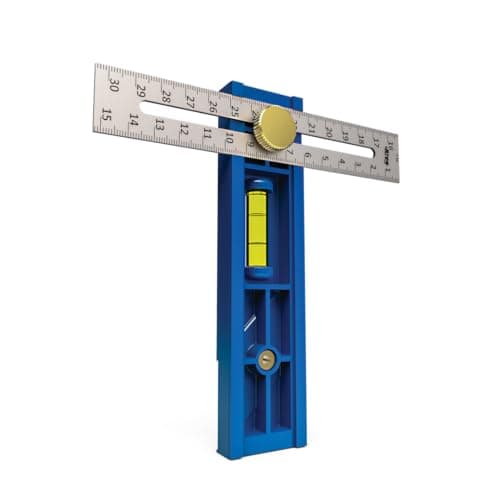
The Kreg KMA2900 Multi-Mark is not a square and does not pretend to be: a sliding alloy-steel rule that works as a depth gauge, a small square, a scribe and a quick measure. It is a convenience tool rather than an accuracy tool, which is exactly why it ends up living in an apron pocket and getting used forty times a day.
And the Woodpeckers tool that is harder to replace
Woodpeckers also makes the Cam-A-Line dowel jig, which is a different proposition from a square: a machined, cam-clamped drilling jig at a price that puts it alongside a benchtop machine. The alternatives there are not layout tools at all, and our doweling jig roundupranks that field properly — including the Milescraft jigs that do the same job for a tenth of the money, with the trade-offs stated.
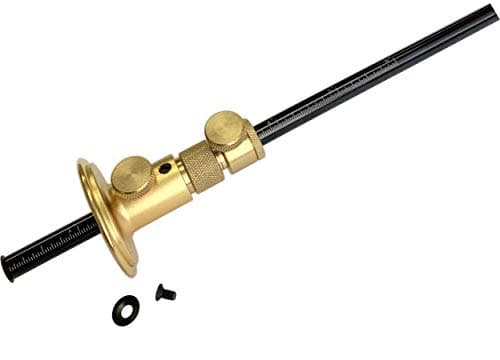
For marking rather than squaring, the iGaging micro-adjust wheel marking gauge is the tool to pair with any square on this page. A wheel gauge cuts the fibers rather than tearing them, and a micro-adjust is what turns a lucky setting into a repeatable one when you are sneaking up on a fit. Our marking gauge roundup covers that field in full.
Side by side, as published
| Tool | Replaces which Woodpeckers job | Published accuracy claim | Also does | Material |
|---|
| Woodpeckers 6 in. Precision Square (the original) | — | Claimed +/- 0.001 in. | Nothing — fixed 90 only | Machined aluminum |
| iGaging combination set (6 + 12 in.) | One-tool layout | Not published | 45, depth, measure, scribe | Hardened steel |
| Starrett C11H-12-4R | The unarguable reference | Not published as a tolerance | 45, depth, measure, level, scribe | Cast-iron head, hardened blade |
| Woodstock D4089 set (4) | Machine setup | Claimed +/- 0.0006 in. | Nothing — fixed 90 only | Hardened steel |
| Swanson S0101 speed square | Fast marks, saw fence | Not published | 45, protractor, rafter scales | Aluminum alloy |
| Kreg KMA2900 Multi-Mark | Pocket layout | Not published | Depth, measure, scribe, small square | Alloy steel |
Every figure above is the maker's own published claim for the exact SKU we link, and we print them as claims because that is what they are: a tolerance on a maker's page is not a certificate, and only a few makers in this category publish one at all. Starrett publishes no numeric tolerance for the C11H on the page we read — the reputation is the claim. We did not check a square against a granite reference, because there is no lab here, which the methodology page states plainly.
What to buy, in order
One layout tool in a first shop: the iGaging combination set, and check it on arrival. A reference you will never argue with, bought once: the Starrett C11H-12-4R. A shop that tunes its own machines: the Woodstock machinist set, which is the best value on this page. Fast marks and a circular-saw fence: the Swanson. An apron tool for the forty small measurements a day: the Kreg Multi-Mark.
And the answer we should not talk you out of: if you want a fixed machined square that stands on the work, does not rust and is published to a claimed thousandth, buy the Woodpeckers. It is a genuinely good tool and it is in our squares roundupon merit for fine joinery. The point of this page is that most people searching for an alternative want one specific thing — a trustworthy 90, a tool that also measures, or a way to check a saw blade — and each of those has a better-value answer than a premium fixed square.