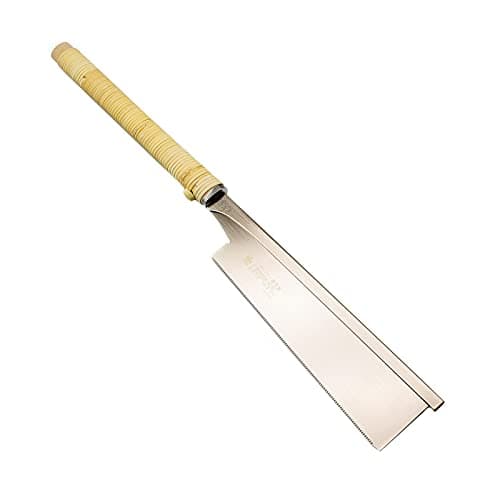
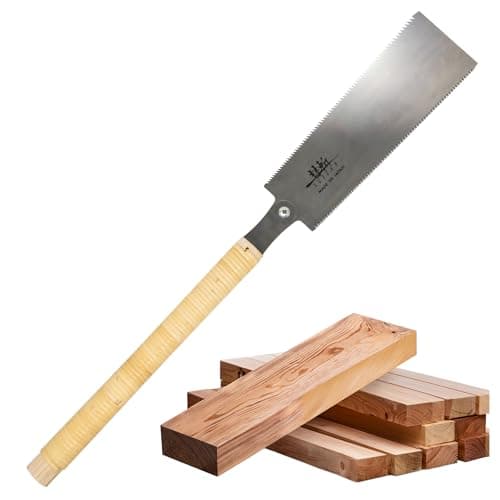
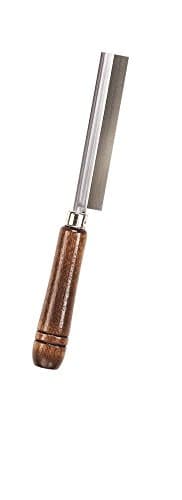
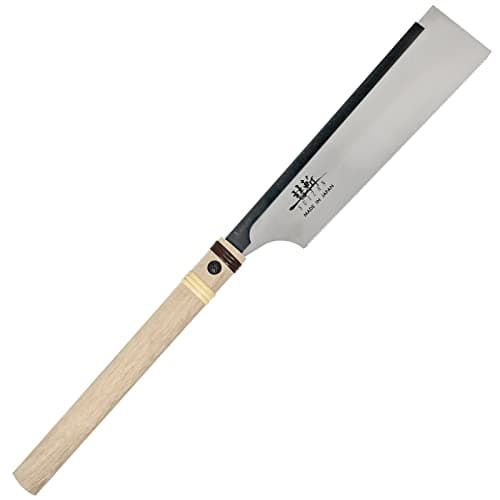
The first real decision in a dovetail saw is not brand or price — it is whether the saw cuts on the push or the pull. And for a beginner, the honest answer is that a Japanese pull saw is easier to learn on. Not better; easier. The reason is mechanical, and worth understanding before you spend.
A Western saw cuts on the push stroke, which puts the blade in compression — and a thin blade in compression wants to buckle. To resist that, Western saws use thicker steel and a rigid folded back, which means a wider kerf. A Japanese saw cuts on the pull stroke, putting the blade in tension, where thinness is no longer a problem. The result is a much thinner blade, a much finer kerf, and a saw that tracks its own line rather than wandering under pressure.
Why does kerf matter for dovetails specifically? Because a dovetail joint is cut to a line and the waste is chopped out afterwards. A narrow kerf removes less material and leaves more margin for a slightly imperfect line — the joint still closes. A wide kerf is less forgiving. That is the whole argument, and it is why our top two picks are both Japanese.
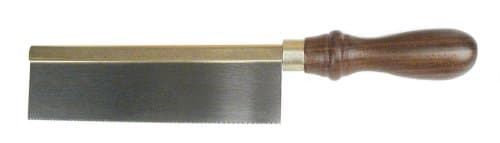
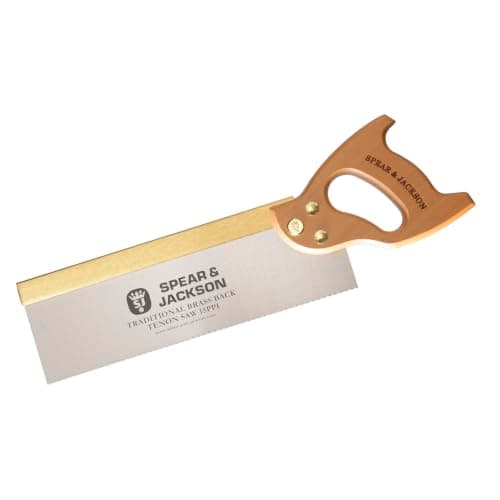
None of which means Western saws are obsolete. A gent's saw or a tenon saw can be resharpened by hand indefinitely, which impulse-hardened Japanese blades cannot. The push stroke lets you lean over and sight down the line, which many people find more intuitive. And if you learned on Western saws, that muscle memory is worth more than any spec on this page — switch only if you want to, not because a roundup told you to.
One more distinction worth having straight: a dovetail saw is a small backsaw with fine teeth for cutting joint sides in thin stock. A tenon saw is a bigger backsaw with coarser teeth for tenon cheeks and shoulders. A ryoba has no back at all and carries rip teeth on one edge and crosscut on the other. All three are here, because a joinery bench eventually wants more than one, and the roundup is ranked for dovetailing first.
If you are assembling a dovetail kit rather than replacing one saw, the saw is one of six tools that actually cut the joint — tools needed to cut dovetails lists all six and what each one decides, and best chisels for dovetails covers the half of the work the saw does not do.
How to read a saw's specification
Teeth per inch (TPI or ppi)
More teeth means a finer, slower cut; fewer teeth means a faster, rougher one. For dovetails in 1/2- to 3/4-inch stock, somewhere in the high teens to low twenties per inch is the useful range. The 15-ppi Spear & Jackson tenon saw here is deliberately coarser because it is cutting deeper; the 52-TPI Zona is deliberately finer because it is cutting model-scale material.
Rip teeth or crosscut teeth
Dovetails are cut along the grain, which is a rip cut — so a rip-filed saw is technically ideal. In practice, fine crosscut teeth cut dovetails perfectly well in most hardwoods, and a great many excellent dovetails have been cut with crosscut dozukis. This is a refinement, not a requirement.
Kerf and set
Kerf is the width of the slot the saw makes; set is how far the teeth are bent sideways to create clearance. Japanese saws use very little set, which is why the kerf is so fine and also why they bind if you twist them. Western saws use more set, which makes them more forgiving of a slightly off-line stroke and harder to steer back onto the line.
Technique matters more than the saw
Three habits fix most sawing problems, and none of them cost anything.
Start with the saw, not with force
Begin the kerf with the weight of the saw only, using your thumb knuckle as a guide against the blade. Two or three light strokes establish the kerf; the saw then follows it. Pushing hard at the start is what makes a saw jump out of the line and scar the workpiece.
Saw to the line, not on it
Leave the line. A dovetail is fitted by paring to the line with a chisel, not by sawing exactly on it. If you saw to split the line, every small error becomes a gap.
Let the eye do the steering
Watch the far side of the cut as much as the near side — that is where a saw goes wrong first. If the kerf drifts, do not force it back; ease off, let the saw self-correct over a few strokes, and the cut straightens. Full step-by-step technique is in our dovetail guide.
By what you are cutting
Dovetails in furniture stock, learning: the Suizan dozuki. Dovetails, cutting often, want a saw that never degrades: the Gyokucho with replaceable blades. One saw for both dovetails and tenons: the Suizan ryoba, which handles rip and crosscut and has no back to limit depth. Western tradition, resharpenable, entry price:the Crown 187 gent's saw. Tenon cheeks and shoulders: the Spear & Jackson. Inlay, small boxes and model-scale work: the Zona.
What we could not verify
We have not cut identical joints with all six saws. Blade lengths, tooth pitches and kerf figures above are the manufacturers' published specifications. The push-versus-pull reasoning is standard mechanics — a blade in tension does not buckle — not a test result.