Skip to content
Dovetail & Dust

HUB 05 · Shop Setup

The Best Shop Lighting

The cheapest upgrade that improves every other tool you own. How much light a shop needs, and the fixtures worth buying.

By Stephen V.Updated How we research
#ad

We earn a commission when you buy through our Amazon links, at no extra cost to you. It never changes our rankings, and we say so when the cheaper tool is the better buy. How this works.

Almost every home shop is under-lit, and almost nobody realizes it until they add a second bank of lights and wonder how they ever worked before. Light is what lets you see a pencil line, spot tear-out before you finish over it, and judge whether a surface is actually flat. It makes every tool you own work better, and it is the cheapest thing on this site.

The units to know are simple. Lumens measure total light output — the number to compare fixtures by, since wattage now tells you only how much electricity is used. Color temperature in kelvin describes the tint: 3,000 K is warm and yellow, 4,000 K is neutral, 5,000 K reads as clean daylight. For a wood shop, 4,000 to 5,000 K is the practical range — cool enough to see detail and judge color, without the clinical blue of the highest figures. CRI describes how faithfully colors appear; higher is better, and it matters when you are matching stain or finish.

As a rough working target, a general workshop wants substantially more light than a garage is built with — the single bulb in the middle of the ceiling is not in the same universe as adequate. The practical approach is to plan for even coverage across the whole ceiling rather than a bright patch in the middle, then add task lighting at the bench and at each machine, because a machine casts a shadow exactly where you are looking.

One thing worth checking before you buy: whether the fixture is plug-in or hardwired. Plug-in fixtures with linkable cords need no electrician and suit a rented or temporary shop. Hardwired fixtures look tidier and free up outlets, but are electrical work — see our workshop power guide for where that line sits.

The short answer

Quick picks

#ProductBest forScorePrice
01
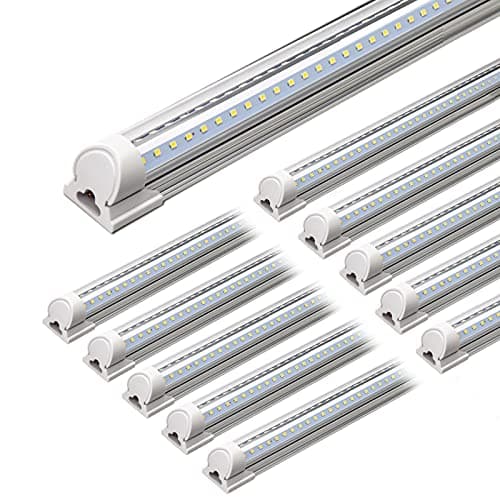
Barrina Barrina T8 LED Shop Lights, 4 ft (10-pack)
Barrina T8 LED Shop Lights, 4 ft (10-pack)

Ten linkable four-foot tubes for about what two premium fixtures cost. The cheapest honest way to make a whole garage genuinely bright.

Best value multi-pack
8.6
$113.99Amazon
02
hykolity Hykolity 4-ft Linkable LED Shop Light (4,400 lm)
Hykolity 4-ft Linkable LED Shop Light (4,400 lm)

A single, bright, linkable fixture at a price where adding one more is never a difficult decision. The unit to buy in ones and twos as the shop grows.

Best single fixture
8.0
$24.29Amazon
03
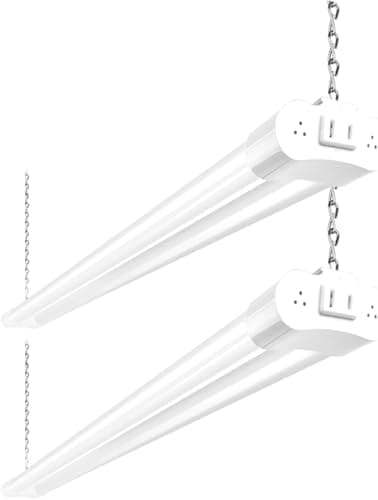
Feit Electric Feit Electric 4-ft LED Utility Shop Light (4,000 lm)
Feit Electric 4-ft LED Utility Shop Light (4,000 lm)

The plug-in hanging fixture that needs no electrician. Hang it from chains or mount it flush, plug it in, and the corner is lit today.

Best plug-in
7.8
$62.83Amazon
04
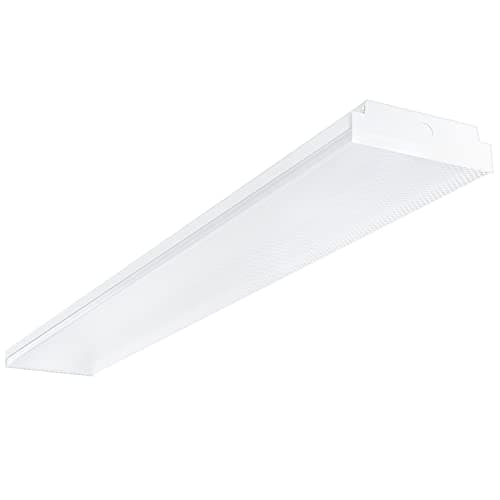
ANTLUX ANTLUX 4-ft LED Wraparound Light (40 W, 4,400 lm)
ANTLUX 4-ft LED Wraparound Light (40 W, 4,400 lm)

A diffused wraparound rather than a bare strip. The frosted lens spreads the light and takes the glare out, which matters when you look up a lot.

Best diffused light
8.4
$36.99Amazon
05
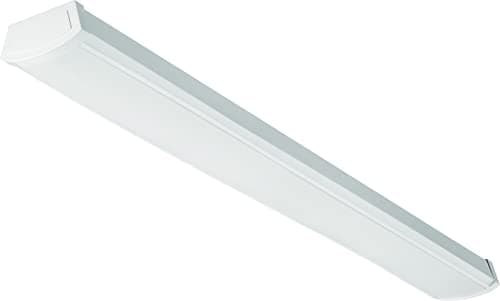
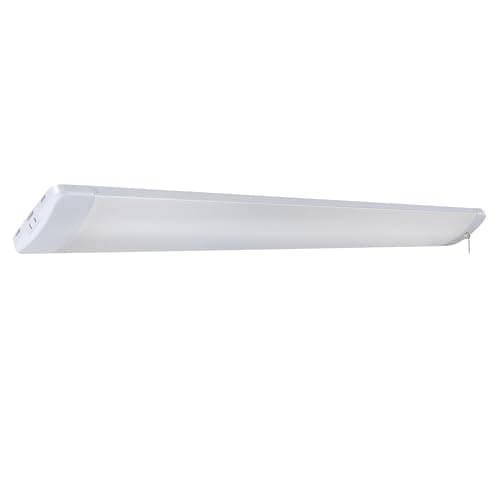
Lithonia Lighting Lithonia Lighting 4-ft Low-Profile LED Wraparound
Lithonia Lighting 4-ft Low-Profile LED Wraparound

A commercial lighting brand's low-profile fixture. Tighter to the ceiling than a hanging shop light, which matters when a low garage ceiling is the constraint.

Best low-profile
7.8
$49.98Amazon

#ad · Live prices from the Amazon Product API, as of Sep 1, 2026. Where we have no verified live price, we show none — we would rather leave a gap than print a number that has rotted.

In detail

The picks, in full

01
Barrina Barrina T8 LED Shop Lights, 4 ft (10-pack)

Best value multi-pack

Barrina T8 LED Shop Lights, 4 ft (10-pack)

4 ft, 40 W each5,500 lm each5,000 K daylightLinkable, 10-pack
8.6/10

Ten linkable four-foot tubes for about what two premium fixtures cost. The cheapest honest way to make a whole garage genuinely bright.

Brightness
9
Color quality
8
Coverage
10
Build
6
Value
10

Pros

  • Enough fixtures in one order to light an entire two-car garage properly
  • Link together end to end, so one outlet feeds a whole run
  • 5,000 K reads as clean daylight, which is what you want for judging finish and grain

Cons

  • Slim tubes with no diffuser — the bare-strip look is not for everyone
  • Fixtures are light plastic; mounting is clips and screws rather than a solid channel

Don't buy this if…

you want a small number of substantial fixtures. Buy fewer, better ones instead.

$113.99View on Amazon

$119.995% off

Price as of Sep 1, 2026. Prices change — Amazon's is the one that counts.

#ad · we may earn a commission from this link to Barrina T8 LED Shop Lights, 4 ft (10-pack)

02
hykolity Hykolity 4-ft Linkable LED Shop Light (4,400 lm)

Best single fixture

Hykolity 4-ft Linkable LED Shop Light (4,400 lm)

4 ft4,400 lm5,000 K daylightLinkable
8.0/10

A single, bright, linkable fixture at a price where adding one more is never a difficult decision. The unit to buy in ones and twos as the shop grows.

Brightness
8
Color quality
8
Coverage
7
Build
7
Value
10

Pros

  • Cheap enough to add fixtures gradually rather than committing to a full lighting plan
  • Linkable, so a later addition still runs off the same supply
  • Bright enough that two of them transform a single-bay garage

Cons

  • Bare-strip styling with no diffuser, so the LEDs are visible from below
  • Buying singles costs more per fixture than a multi-pack

Don't buy this if…

you already know you need eight fixtures. The multi-pack is far cheaper per light.

$24.29View on Amazon

$29.9919% off

Price as of Sep 1, 2026. Prices change — Amazon's is the one that counts.

#ad · we may earn a commission from this link to Hykolity 4-ft Linkable LED Shop Light (4,400 lm)

03
Feit Electric Feit Electric 4-ft LED Utility Shop Light (4,000 lm)

Best plug-in

Feit Electric 4-ft LED Utility Shop Light (4,000 lm)

4 ft, 52 W4,000 lm5,000 KPlug-in, linkable, hanging or flush
7.8/10

The plug-in hanging fixture that needs no electrician. Hang it from chains or mount it flush, plug it in, and the corner is lit today.

Brightness
8
Color quality
8
Coverage
7
Build
8
Value
8

Pros

  • Plugs into an outlet, so no wiring work and no waiting on an electrician
  • Links to further fixtures from one supply
  • Hangs on chain or mounts flush, so it suits a rented garage as well as a fitted shop

Cons

  • A hanging cord and plug is one more thing across the ceiling
  • Fewer lumens per fixture than the big multi-packs, so a large shop needs several

Don't buy this if…

you are wiring a shop from scratch. Hardwired fixtures look tidier and free the outlets.

$62.83View on Amazon

Price as of Sep 1, 2026. Prices change — Amazon's is the one that counts.

#ad · we may earn a commission from this link to Feit Electric 4-ft LED Utility Shop Light (4,000 lm)

04
ANTLUX ANTLUX 4-ft LED Wraparound Light (40 W, 4,400 lm)

Best diffused light

ANTLUX 4-ft LED Wraparound Light (40 W, 4,400 lm)

4 ft, 40 W4,400 lm4,000 KWraparound diffuser
8.4/10

A diffused wraparound rather than a bare strip. The frosted lens spreads the light and takes the glare out, which matters when you look up a lot.

Brightness
8
Color quality
9
Coverage
8
Build
8
Value
9

Pros

  • Diffuser softens the source so you are not looking straight at LEDs from the bench
  • 4,000 K is a slightly warmer white that many people find easier over long sessions
  • Enclosed lens keeps dust off the emitters, which in a wood shop is not a small thing

Cons

  • A diffuser costs you some measured output compared with a bare-strip fixture
  • Bulkier to mount than a slim tube

Don't buy this if…

you want maximum lumens per dollar. Bare strips are brighter for the money.

$36.99View on Amazon

$39.998% off

Price as of Sep 1, 2026. Prices change — Amazon's is the one that counts.

#ad · we may earn a commission from this link to ANTLUX 4-ft LED Wraparound Light (40 W, 4,400 lm)

05
Lithonia Lighting Lithonia Lighting 4-ft Low-Profile LED Wraparound

Best low-profile

Lithonia Lighting 4-ft Low-Profile LED Wraparound

4 ft4,000 K120 VLow-profile wraparound
7.8/10

A commercial lighting brand's low-profile fixture. Tighter to the ceiling than a hanging shop light, which matters when a low garage ceiling is the constraint.

Brightness
7
Color quality
9
Coverage
7
Build
9
Value
7

Pros

  • Sits close to the ceiling — nothing to catch a long board on the way past
  • Made by a commercial fixture manufacturer rather than an import house brand
  • Even, diffused output that suits a permanently fitted shop

Cons

  • Hardwired installation, so it is electrician work in most shops
  • Fewer lumens per dollar than the value multi-packs

Don't buy this if…

you rent the space or want to plug it in. Buy the plug-in hanging fixture instead.

$49.98View on Amazon

$54.999% off

Price as of Sep 1, 2026. Prices change — Amazon's is the one that counts.

#ad · we may earn a commission from this link to Lithonia Lighting 4-ft Low-Profile LED Wraparound

How much light does a shop need?

Work in lumens, not fixtures

Add up the lumens of the fixtures you are considering and compare that against your floor area. A two-car garage is a large space and one or two fixtures will not cover it; a run of linked four-foot lights along the length of the ceiling will. The mistake people make is buying one very bright fixture, which produces a bright patch and deep shadows rather than usable light.

Even coverage beats raw brightness

Two rows of lights running the length of the shop, positioned so they are not directly behind you at the bench, produce far more usable light than the same lumens concentrated in the middle. Shadows are the real enemy: you want light coming from more than one direction so your own body and the machine you are using do not black out the cut.

Color temperature and CRI

4,000 K is a neutral white that many people find comfortable for long sessions; 5,000 K reads as daylight and shows detail slightly better. Either is fine. What matters more is consistency — mixing 3,000 K and 5,000 K fixtures in one shop makes color judgment genuinely harder. If you finish and stain, look for a higher CRI figure so the color you mix is the color you get.

Bare strip, wraparound or diffused

Bare-strip fixtures give the most lumens per dollar and look industrial. Wraparound fixtures put a diffuser between you and the LEDs, which reduces glare when you look up and keeps dust off the emitters — a real consideration in a wood shop. Enclosed fixtures cost some measured output for that comfort.

Task lighting and the bits people forget

Ceiling light is general light. You also want a task light at the bench, and something you can move — a magnetic or clamp light that goes wherever the work is. A raking light held low across a surface is the standard way to see whether a board is actually flat or whether a finish has missed a patch, and no amount of ceiling light substitutes for it.

Two practical notes. Cold garages: check the fixture's rated operating temperature, because some LED drivers are unhappy starting well below freezing. And dust: an enclosed fixture stays brighter over years in a wood shop than an open one, simply because the dust settles on the diffuser rather than the emitters, and the diffuser can be wiped.

Segmenting by shop and budget

Whole garage, tight budget: a multi-pack of linkable strip lights. Nothing else comes close on lumens per dollar, and one outlet feeds a whole run.

Rented or temporary shop: plug-in hanging fixtures. No wiring work, and they come with you when you move.

Fitted shop: hardwired wraparound fixtures on a switched circuit, with the clearance to hold a long board overhead without hitting one.

Finishing work: prioritize CRI and consistent color temperature across every fixture, and add a movable task light for raking inspection.

How we ranked these

From published manufacturer specifications (lumen output, wattage, color temperature, linkability, mounting options) plus the pattern in owner feedback read at volume. We have not measured illuminance, color rendering or output over time — we do not run a lab, and our methodology page says so plainly. Prices come from the live feed.
How we picked

We do not run a testing lab

We researched published manufacturer specifications, manuals and spec sheets, ran the arithmetic those specs support, and read owner reviews at volume, then scored each tool against a published rubric. The scores are judgments from documented research — they are not measurements we took, because we do not have a lab and we are not going to pretend we do. Where a number came from a manufacturer's document, we name it and link it in Sources.

Questions

Frequently asked

How many lumens do I need in a garage workshop?
More than a garage ships with, and the answer scales with floor area rather than being a single figure. Compare fixtures by total lumens, plan for even coverage across the whole ceiling rather than one bright patch, and add task lighting at the bench and each machine.
What color temperature is best for a wood shop?
Between 4,000 K and 5,000 K. 4,000 K is a comfortable neutral white and 5,000 K reads as daylight with slightly better detail. More important than the exact figure is using the same temperature throughout, because mixed lighting makes judging color and finish difficult.
Are LED shop lights worth it over fluorescent?
Yes. LEDs start instantly in the cold, which fluorescent tubes famously do not in an unheated garage, they use less power for the same light, and they do not contain mercury or need ballast replacement. There is no practical argument left for new fluorescent shop lighting.
Do I need an electrician to install shop lights?
Not for plug-in linkable fixtures, which hang from chains or mount flush and plug into an existing outlet. Hardwired fixtures and new switched circuits are electrical work and are regulated in most places — that is where to call someone.

Keep reading

Receipts

Sources

We do not run a testing lab, and we do not pretend to. Our picks come from published manufacturer specifications and manuals, the arithmetic those specs support, and owner reviews read at volume. Where we could not verify something, we say so on the page rather than quietly leaving it out. Read our full method.