Skip to content
Dovetail & Dust

HUB 05 · Shop Setup

The Best Wood Moisture Meter

Ranked on accuracy and how they read — plus the moisture numbers that explain why a perfectly made table top splits in January.

By Stephen V.Updated How we research
#ad

We earn a commission when you buy through our Amazon links, at no extra cost to you. It never changes our rankings, and we say so when the cheaper tool is the better buy. How this works.

Almost every mysterious woodworking failure — the table top that splits, the door that will not close in summer, the panel that cups a month after finishing — is wood moving because its moisture content changed. A meter is how you stop guessing.

Here is the mechanism, briefly, because the tool only makes sense with it. Wood is hygroscopic: it absorbs and releases moisture until it reaches equilibrium with the air around it, and it changes dimension across the grain as it does. That equilibrium point is called equilibrium moisture content, and it depends on the relative humidity where the piece lives. Wood in a heated house in winter equilibrates far lower than wood in a damp garage.

Which gives you the actual rule: build with lumber that has equilibrated to the environment the finished piece will live in. A board bought at 12% and worked immediately will keep drying inside a heated house, shrinking after you have joined it. The common guidance for furniture destined for a heated interior is roughly 6–8% moisture content; for a workshop or an unheated space, higher. A meter tells you which of those you are holding.

The tool question is pin or pinless. Pin meters push two electrodes into the wood and measure electrical resistance between them, which is a direct measure of what is happening inside the board at pin depth. They cost less, they work on rough and curved stock, and they leave two small holes. Pinless metersuse a capacitance-based sensor pressed against the surface to read a volume below it — no holes, deeper sampling, but they need a flat clean face to sit on and they are more affected by wood density.

For most woodworkers, a cheap pin meter answers the question completely. The holes go on the end of the board that becomes offcut, and the reading is what you needed. Pinless is worth the premium if you check finished surfaces, veneer or thick slabs — which is exactly why the ranking below spans both.

The short answer

Quick picks

#ProductBest forScorePrice
01
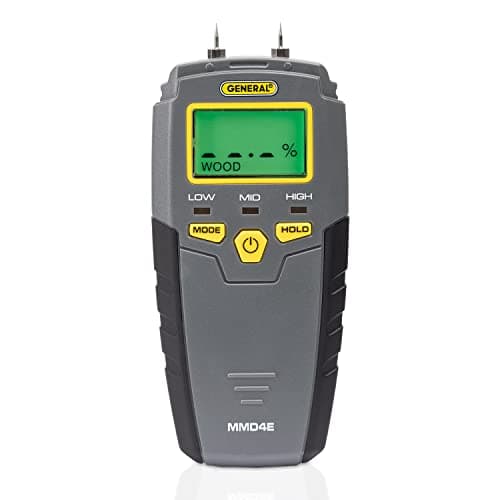
General Tools General Tools MMD4E Pin Moisture Meter
General Tools MMD4E Pin Moisture Meter

The meter that taught most woodworkers what their lumber was actually doing. Pin-type, cheap, and accurate enough to tell 8% from 14% — which is the only decision you need it for.

Best overall
8.0
$37.70Amazon
02
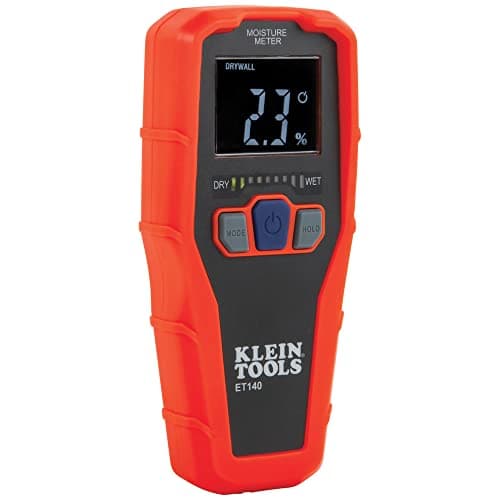
Klein Tools Klein Tools ET140 Pinless Moisture Meter
Klein Tools ET140 Pinless Moisture Meter

Pinless at a pin-meter price. It reads a published three-quarters of an inch below the surface without marking the board, which is the whole point on anything already finished.

Best value pinless
8.2
$49.97Amazon
03
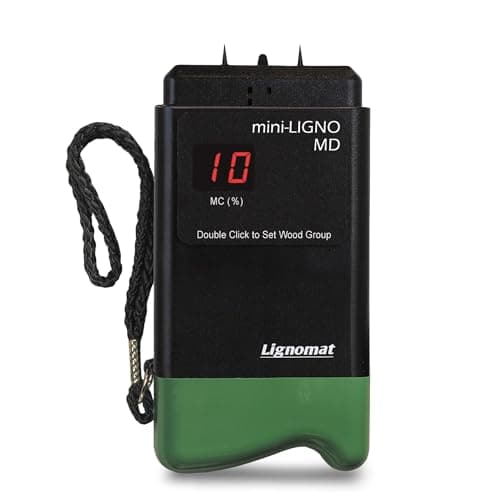
Lignomat Lignomat Mini-Ligno MD Pin Moisture Meter
Lignomat Mini-Ligno MD Pin Moisture Meter

The woodworker's pin meter. Built for lumber rather than for water-damage inspection, with species compensation that makes a reading on walnut mean the same as a reading on pine.

Best for lumber
7.6
$99.00Amazon
04
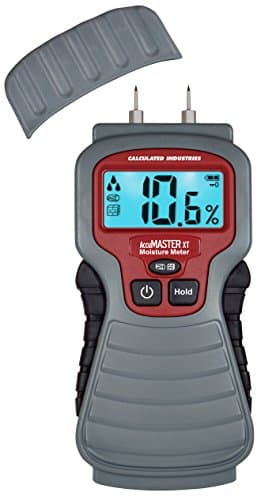
Calculated Industries Calculated Industries 7440 AccuMASTER XT Moisture Meter
Calculated Industries 7440 AccuMASTER XT Moisture Meter

The pin meter with a backlit screen and a slightly better feel in the hand. Same job as the General, marginally nicer to use in a dim garage.

Best budget alternative
8.0
$50.29Amazon
05
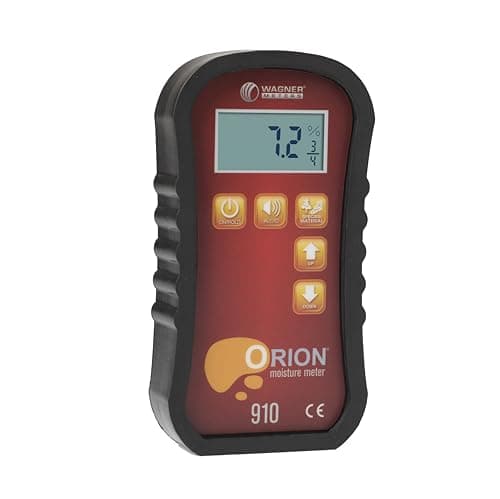
Wagner Meters Wagner Meters Orion 910 Pinless Wood Moisture Meter Kit
Wagner Meters Orion 910 Pinless Wood Moisture Meter Kit

The professional pinless meter. Deep, non-damaging readings plus an on-site calibrator — the tool for someone whose money depends on the moisture number being right.

Best professional
8.6
$430.00Amazon

#ad · Live prices from the Amazon Product API, as of Sep 1, 2026. Where we have no verified live price, we show none — we would rather leave a gap than print a number that has rotted.

In detail

The picks, in full

01
General Tools General Tools MMD4E Pin Moisture Meter

Best overall

General Tools MMD4E Pin Moisture Meter

Pin typeLCD displayWood + building materialsAudible alert
8.0/10

The meter that taught most woodworkers what their lumber was actually doing. Pin-type, cheap, and accurate enough to tell 8% from 14% — which is the only decision you need it for.

Accuracy
8
Depth
6
Ease of use
9
Build
7
Value
10

Pros

  • Pins read the moisture inside the board, not just the surface — that is the number that matters
  • Cheap enough that there is no excuse for guessing
  • Color-coded LED and audible alert make it readable without interpreting a number

Cons

  • Pins leave two small holes — fine on rough stock, annoying on a finished face
  • Reads at pin depth only, so a thick board can be drier outside than in

Don't buy this if…

you check finished surfaces or veneer. Pin holes there are damage, not a measurement.

$37.70View on Amazon

Price as of Sep 1, 2026. Prices change — Amazon's is the one that counts.

#ad · we may earn a commission from this link to General Tools MMD4E Pin Moisture Meter

02
Klein Tools Klein Tools ET140 Pinless Moisture Meter

Best value pinless

Klein Tools ET140 Pinless Moisture Meter

Pinless sensorReads to 3/4 in deepWood / drywall / masonryHandheld
8.2/10

Pinless at a pin-meter price. It reads a published three-quarters of an inch below the surface without marking the board, which is the whole point on anything already finished.

Accuracy
7
Depth
8
Ease of use
9
Build
8
Value
9

Pros

  • No holes, so you can check a finished panel or a veneered face
  • 3/4-inch published read depth samples more of the board than pins do
  • Costs about the same as the good pin meters

Cons

  • Pinless meters are sensitive to surface contact — a rough or curved face reads badly
  • Species and density affect the reading more than they do with pins

Don't buy this if…

your stock is rough-sawn and cupped. Pinless sensors need a flat face to sit on.

$49.97View on Amazon

Price as of Sep 1, 2026. Prices change — Amazon's is the one that counts.

#ad · we may earn a commission from this link to Klein Tools ET140 Pinless Moisture Meter

03
Lignomat Lignomat Mini-Ligno MD Pin Moisture Meter

Best for lumber

Lignomat Mini-Ligno MD Pin Moisture Meter

Pin typeSpecies compensationMade for woodworkersCompact body
7.6/10

The woodworker's pin meter. Built for lumber rather than for water-damage inspection, with species compensation that makes a reading on walnut mean the same as a reading on pine.

Accuracy
9
Depth
6
Ease of use
8
Build
8
Value
7

Pros

  • Species settings correct for density, which is the biggest source of error in cheap meters
  • Designed around wood rather than being a building-inspection tool with a wood mode
  • Small enough to live in an apron pocket at the lumberyard

Cons

  • Costs two to three times the general-purpose pin meters
  • Fewer non-wood uses, so it does not double as a house tool

Don't buy this if…

you buy kiln-dried stock from one supplier and never question it. The cheap meter tells you the same thing.

$99.00View on Amazon

Price as of Sep 1, 2026. Prices change — Amazon's is the one that counts.

#ad · we may earn a commission from this link to Lignomat Mini-Ligno MD Pin Moisture Meter

04
Calculated Industries Calculated Industries 7440 AccuMASTER XT Moisture Meter

Best budget alternative

Calculated Industries 7440 AccuMASTER XT Moisture Meter

Pin typeBacklit LCDHandheldWood and building materials
8.0/10

The pin meter with a backlit screen and a slightly better feel in the hand. Same job as the General, marginally nicer to use in a dim garage.

Accuracy
8
Depth
6
Ease of use
9
Build
8
Value
9

Pros

  • Backlit display is genuinely easier to read leaning over a lumber rack
  • Reads wood, drywall and masonry, so it doubles as a house tool
  • Priced alongside the General with a slightly more solid body

Cons

  • Pin holes again — the same limitation as every pin meter
  • No meaningful accuracy advantage over the cheaper General

Don't buy this if…

you already own a working pin meter. There is nothing here worth replacing it for.

$50.29View on Amazon

Price as of Sep 1, 2026. Prices change — Amazon's is the one that counts.

#ad · we may earn a commission from this link to Calculated Industries 7440 AccuMASTER XT Moisture Meter

05
Wagner Meters Wagner Meters Orion 910 Pinless Wood Moisture Meter Kit

Best professional

Wagner Meters Orion 910 Pinless Wood Moisture Meter Kit

Pinless sensorDeep-depth readingOn-site calibrator incl.Kit case
8.6/10

The professional pinless meter. Deep, non-damaging readings plus an on-site calibrator — the tool for someone whose money depends on the moisture number being right.

Accuracy
10
Depth
10
Ease of use
9
Build
9
Value
5

Pros

  • Reads deeper into the board than the budget pinless meters, so a thick slab is measured properly
  • On-site calibrator lets you prove the meter is right rather than trust it
  • No pin holes anywhere, ever

Cons

  • Costs roughly ten times a good pin meter
  • Overkill for anyone not selling the wood or the work

Don't buy this if…

you build for yourself. A thirty-dollar pin meter answers the same question well enough.

$430.00View on Amazon

Price as of Sep 1, 2026. Prices change — Amazon's is the one that counts.

#ad · we may earn a commission from this link to Wagner Meters Orion 910 Pinless Wood Moisture Meter Kit

How to actually use a moisture meter

Take several readings, not one

A board is not uniform. Read near both ends and in the middle, and on both faces if you can. The ends dry faster than the middle, so an end reading flatters the board; a middle reading that is much higher tells you the board is still drying and is not ready.

Read on the offcut end

With a pin meter, put the holes where they will be cut away. On a rough board this hardly matters; on anything already dimensioned, it matters a great deal.

Let the wood acclimate, then re-read

The single most useful habit: bring lumber into the space it will be worked and used, sticker it so air reaches all faces, and leave it for a couple of weeks. Read it when it arrives and read it again before you cut. If the number has stopped moving, the wood has equilibrated and it is ready. If it is still falling, wait — this is the step that prevents most seasonal-movement failures.

Understanding the numbers

  • Above about 19%: too wet to work. This is roughly where construction lumber is sold and where mold and decay concerns start.
  • 9–12%: typical of air-dried lumber and of kiln-dried stock stored in a garage or an unheated shop. Fine for outdoor and shop furniture; too wet for a heated interior.
  • 6–8%: the usual target for furniture destined for a heated interior in most climates.
  • Differences between boards matter as much as absolute numbers. Gluing a 6% board to a 12% board guarantees a stressed joint, whatever the average.

Species and density affect the reading

Both technologies are calibrated for a reference species, and dense woods read differently from light ones. Better meters have species or density settings for exactly this reason — the Lignomat and the Wagner in this roundup both address it. On a basic meter, treat the number as a good relative indicator rather than a laboratory value, which for deciding "ready or not" is entirely sufficient.

Designing for movement anyway

A meter reduces surprises; it does not abolish wood movement. Wood expands and contracts across the grain with the seasons no matter what you do, so the joinery has to allow it: table tops fastened with buttons or slotted screw holes rather than glued down solid, panels floating in frames rather than glued in, and breadboard ends pinned in elongated holes. A meter plus movement-tolerant joinery is the complete answer; either alone is half of one.

By budget

Everyone should own at least: the General Tools MMD4E, which costs less than a decent router bit and answers the question. No holes wanted: the Klein ET140, pinless at a pin-meter price. Serious about lumber: the Lignomat Mini-Ligno MD, built for wood rather than for building inspection. Selling the work: the Wagner Orion 910, with an on-site calibrator so you can prove the reading.

What we could not verify

We have not compared these meters against oven-dry reference samples. Measurement types, read depths, display features and included accessories above are the manufacturers' published specifications. The equilibrium moisture content guidance is standard, widely published wood-technology practice, not a measurement we took.
How we picked

We do not run a testing lab

We researched published manufacturer specifications, manuals and spec sheets, ran the arithmetic those specs support, and read owner reviews at volume, then scored each tool against a published rubric. The scores are judgments from documented research — they are not measurements we took, because we do not have a lab and we are not going to pretend we do. Where a number came from a manufacturer's document, we name it and link it in Sources.

Questions

Frequently asked

What moisture content should wood be for furniture?
Roughly 6–8% for furniture that will live in a heated interior in most climates, and higher for pieces destined for a garage, shop or outdoors. More important than the absolute number is that the wood has stopped changing — read it, wait two weeks, read it again.
Pin or pinless moisture meter?
Pin meters cost less, work on rough and curved stock, and measure inside the board at pin depth — at the cost of two small holes. Pinless meters leave no marks and sample a deeper volume, but need a flat clean surface and are more affected by wood density. For most woodworkers a pin meter is entirely sufficient.
Do I need a moisture meter if I buy kiln-dried lumber?
Yes, because kiln-dried lumber does not stay at its kiln moisture content. It re-absorbs moisture from wherever it is stored, so a kiln-dried board that has sat in a damp yard or your garage for six months is no longer at 7%. The meter tells you what you actually have.
How long should lumber acclimate before use?
Long enough that the reading stops changing — commonly a couple of weeks for dimensioned stock stickered with air moving around it, and considerably longer for thick slabs. That is precisely why a meter is useful: it turns "long enough" from a guess into an observation.
Why did my table top split even though the joints were tight?
Almost always wood movement: a top glued or screwed down solid cannot shrink across its width as it dries, so it splits instead. The fix is joinery that allows movement — buttons, slotted holes, floating panels — and building with wood that has already equilibrated to where the piece will live.

Keep reading

Receipts

Sources

We do not run a testing lab, and we do not pretend to. Our picks come from published manufacturer specifications and manuals, the arithmetic those specs support, and owner reviews read at volume. Where we could not verify something, we say so on the page rather than quietly leaving it out. Read our full method.