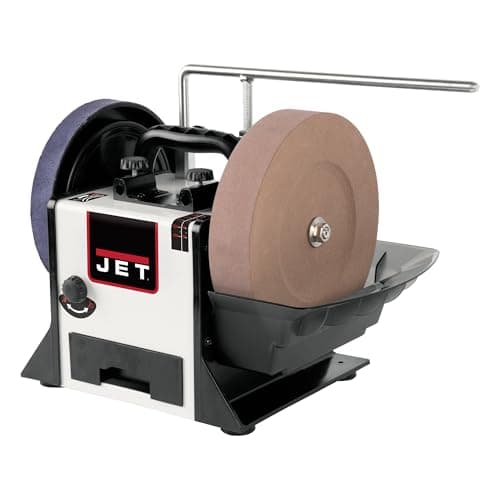
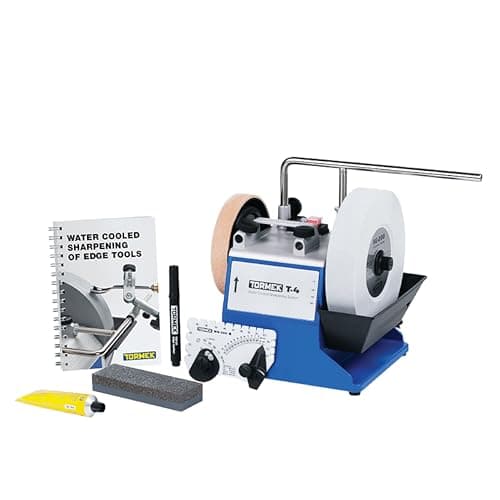
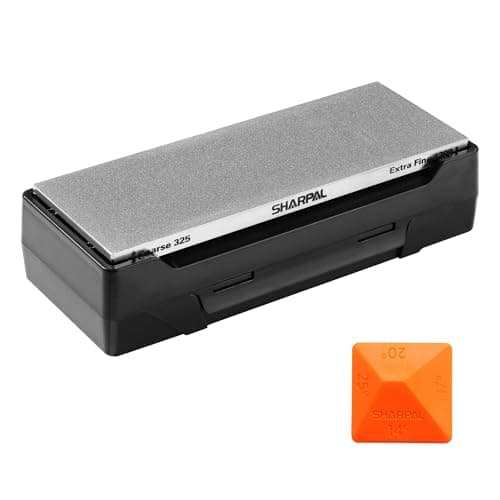
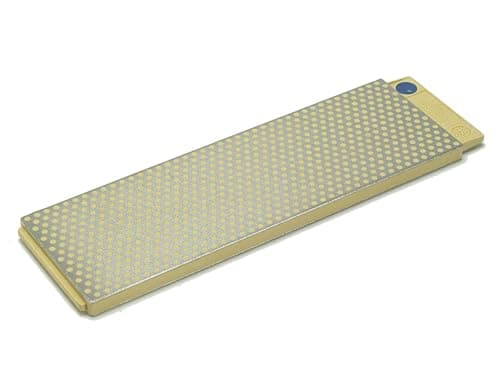
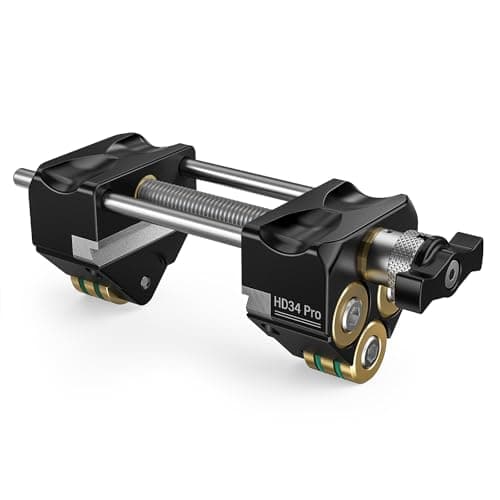
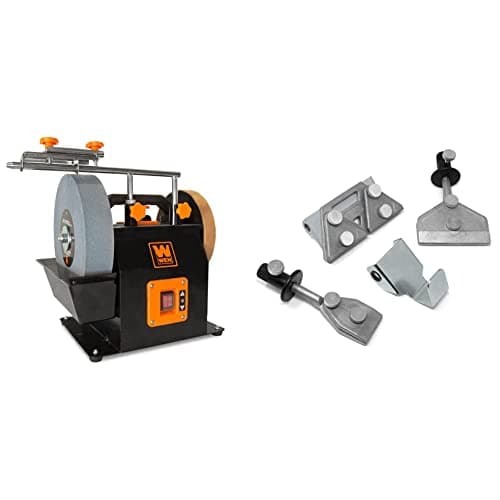
If what you want is a water-cooled wheel for less money, buy the WEN BG4270T — a 10 in. cooled wheel with two-direction rotation, and this listing bundles WEN's own 42704B four-piece jig kit, which is most of its accessory range. If you want variable wheel speed, the JET JWS-10 is the step up. If it is the jig system you want and the price is the obstacle, the honest answer is the Tormek T-4: the same jigs and the same cooled-wheel principle in a smaller machine. And for a great many shops the real alternative is no machine at all — the SHARPAL 162N diamond plate with the Hongdui HD34 honing guide sharpens bench chisels and plane irons perfectly for a small fraction of any machine here, with the DMT DuoSharp as the heavy-removal plate if your tools need reshaping rather than honing.
Prices beside each pick come from our live price layer, last checked November 21, 2026.
What a Tormek is known for
Three things, and they are worth separating because the alternatives cover them unevenly.
A wheel that cannot burn an edge. A dry bench grinder spins fast enough that friction can take a thin edge past the temperature at which its heat treatment holds. The steel colors, and that section will not hold an edge again until it has been ground back past the damage. A water-cooled wheel turns slowly and carries heat away continuously, which makes that failure effectively impossible.
A jig system that repeats an angle.This is the part people underrate. Holding a chisel at 30 degrees is a skill; holding it at the same 30 degrees next month is a different skill. Tormek's jig range — square-edge, short-tool, gouge, knife, axe, scissors, turning tools — is why the machine has the reputation it does, and it is the thing the cheap machines do not match.
A leather honing wheel on the same machine, so grinding and honing happen in one setup rather than two.
On the published numbers we have to be careful. Tormek's own site was not reachable from our build machine on the day this page was written, and the distributor listings disagree: they agree on a 250 mm stone turning at about 90 RPM on a 200 W continuous-duty motor, but the warranty term is given as 7 years in one distributor's product sheet and 8 in others. We print the figures that agree and neither warranty number, because we could not confirm it at the source.
Which of the two problems do you actually have?
This is the whole decision and it takes one minute.
If your problem is removing metal— a chipped chisel, a plane iron with a rounded-over bevel, a rack of turning gouges that need reshaping, a badly ground factory bevel — then you need a wheel, and the cooled wheel is the one that will not cost you the temper. Any of the three machines below solves this, and the cheapest of them solves it about as well as the dearest.
If your problem is holding an angle— your tools are in reasonable shape and you just cannot get a consistent, repeatable edge — then you do not need a machine at all. You need a flat abrasive and a guide, which together cost less than the cheapest wheel here. Buying a wet grinder to solve an angle problem is the single most common expensive mistake in shop sharpening.
If your problem is turning tools, you are the customer the expensive machine was designed for. Gouges are sharpened constantly, they have curved bevels that freehand work ruins, and the jigs that hold them are exactly where the cheap machines are thinnest. This is the one case where we would tell you to think hard before saving the money — see best wood turning tools for what that tooling looks like and best wood lathe under $1,000 for why the sharpening budget belongs in the lathe budget.
Route one: a cheaper cooled wheel
The principle is not proprietary. A large-diameter stone turning slowly through a water bath removes metal without heating the edge, and three machines here do that for well under the price of the market leader.
What you get.The cooled wheel itself, which is the part that protects the tool. A 10 in. wheel on the WEN and the JET, which cuts a shallower hollow grind than a small wheel — worth having on plane irons, where a deep hollow is disliked. Two-direction rotation on the WEN, which is genuinely unusual at the price and changes which way the burr forms. Variable wheel speed on the JET, which lets you run faster to shape and slower to finish.
What you give up. Jigs, mostly. The jig ecosystem is the real premium, and it is also the thing that makes a wheel repeatable rather than merely safe. Check that a jig exists for the specific tool you care about before you buy a budget machine, not after. Fit and finish is the other gap: expect to true a budget wheel before you trust it, and expect the fence and rest to need setting.
Route two: the same jig system, a smaller machine
If the jigs are what you want, there is an obvious answer that we should not talk you out of: the small machine from the same maker takes the same jigs. The Tormek T-4 is a real alternative to a T-8 rather than a different kind of thing, and it costs meaningfully less.
What the smaller machine gives up is wheel size and duty cycle. For a shop sharpening bench chisels, plane irons and kitchen knives in short sessions, that is very little. For a turner working through a rack of gouges back to back, it is the difference the bigger machine is for.
Route three: no machine at all
Here is the arithmetic that most sharpening pages avoid. A double-sided 8 × 3 in. diamond plate and a good honing guide, together, cost a small fraction of the cheapest machine on this page. That combination sharpens every bench chisel and plane iron in a normal shop to a better edge than a wheel does, because a wheel grinds and a stone hones.
Why a diamond plate and not a waterstone.Waterstones cut beautifully and dish as they do it, which means you must flatten the stone as well as the tool — the single most common reason a beginner's edges get worse rather than better. A diamond plate stays flat, works dry or with water, needs no soaking and no flattening. The full comparison is on waterstones vs diamond plates.
Why a guide and not freehand. A guide is the cheap half of what a Tormek sells you. It holds the bevel at a set angle through the stroke, so the second sharpening matches the first and the bevel does not round over. It is the single highest-value purchase in sharpening and it costs about as much as lunch. The field is ranked on best honing guide, and the number to set it to is argued out on what angle to sharpen a chisel.
Where the stone route genuinely fails.Reshaping. Taking a chipped edge back by a millimeter, or regrinding a factory bevel, is twenty minutes of unpleasant work on a fine plate and two minutes on any wheel. That is what the coarse DMT DuoSharp is for here, and it is also the honest argument for owning a wheel eventually. It also fails on curved bevels — carving gouges and turning tools — which a flat stone cannot follow.
What about a dry bench grinder with a white wheel?
It is the cheapest wheel of all, and it is a real option that we are not going to pretend does not exist: a slow-speed grinder with a friable aluminum-oxide wheel and a light touch grinds tools all over the world. But the failure mode is the one the whole water-cooled category exists to remove — a moment of inattention on a thin edge and the steel is blued. If you go that way, go slow-speed, dress the wheel often, use a light touch with frequent dips, and watch the color. The machines on this page remove that risk entirely, which is what you are paying for.
Side by side
| Route | Solves burning | Solves angle repeatability | Reshapes a chipped edge | Published note |
|---|
| Tormek T-8 (the original) | Yes | Yes — full jig range | Yes, slowly by design | 250 mm stone, ~90 RPM, 200 W (distributor listings) |
| WEN BG4270T | Yes | Partly — 4-piece jig kit included | Yes | 10 in. wheel, two-direction rotation |
| JET JWS-10 | Yes | Partly — narrower jig range | Yes | 10 in. wheel, 150 RPM, variable speed, 120V |
| Tormek T-4 | Yes | Yes — takes the same jigs | Yes, lighter duty cycle | Compact housing, Tormek jig compatible |
| SHARPAL 162N + honing guide | Not applicable — hand power | Yes, with the guide | Slowly | 8 × 3 in. plate, coarse / fine |
| DMT W250CXNB DuoSharp | Not applicable — hand power | Yes, with the guide | Yes — this is its job | 10 in. plate, coarse / extra-coarse |
| Hongdui HD34 honing guide | Not applicable | Yes — this is its only job | No | 0.1–3.2 in. blade width, dual rollers |
Every figure is the maker's published specification for the exact listing we link, except the Tormek row, which is quoted from distributor listings and labeled as such because tormek.com could not be fetched from our build machine. We have not run these machines side by side and do not claim to have — there is no lab here, as the methodology page states.
What to buy, in order
Six bench chisels and a couple of plane irons, and you want them properly sharp: the SHARPAL 162N plus the Hongdui HD34 guide, and spend the rest on wood. Tools that need reshaping as well as honing: add the DMT DuoSharp, or skip straight to a wheel. You want a cooled wheel and the lowest price it comes at: the WEN BG4270T, jig kit included. You want a cooled wheel with variable speed and a bit more machine: the JET JWS-10. You want the Tormek jig system and cannot justify the full-size machine: the Tormek T-4, which is the alternative to a Tormek that is still a Tormek.
The category ranked without reference to any one brand is on best sharpening systems, the abrasives on best sharpening stones, and the technique itself on how to sharpen chisels.