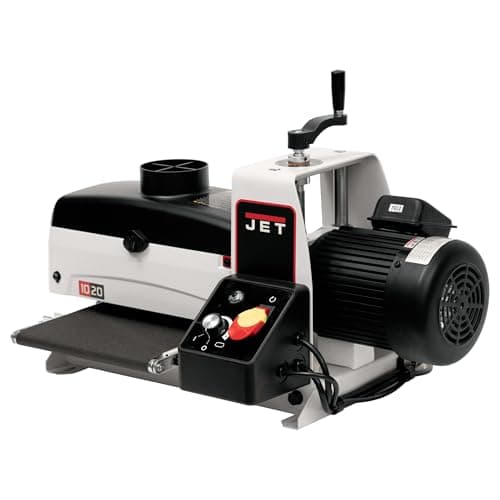
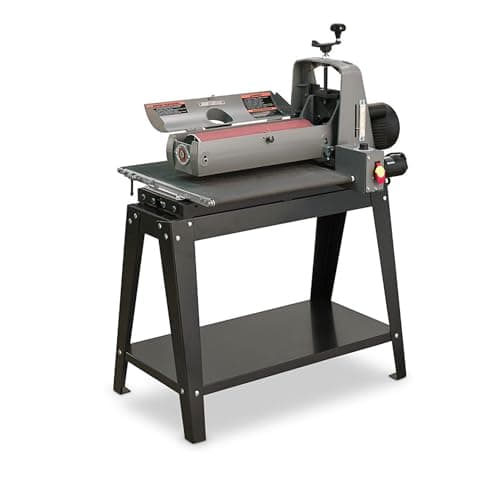
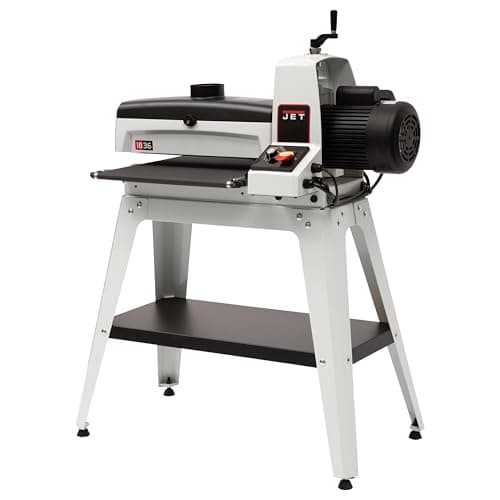
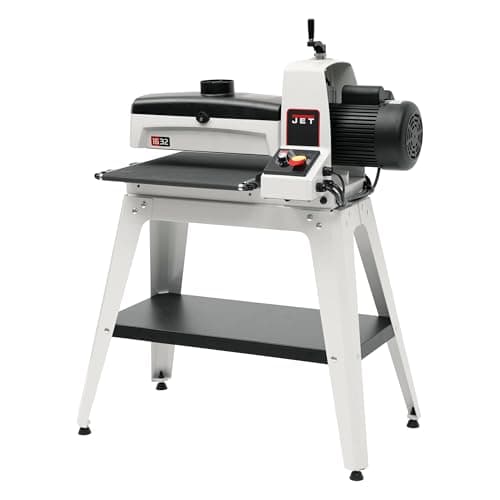
A drum sander is not a faster sander. It is a thicknessing machine that leaves a sanded surface — and that distinction decides whether you need one at all. It removes a few thousandths of an inch per pass across the full width of a panel, which is exactly what you want after a glue-up and exactly what you do not want when you are flattening rough stock.
The specification that matters is not the drum diameter or the motor label. It is two-pass width. Every machine here has an open-ended drum, meaning the drum is supported at one end only, so you can run a panel through, rotate it 180 degrees, and run the other half. A 16-inch drum therefore handles a 32-inch panel. That number — not the one on the badge — is what tells you whether a cabinet door fits.
The second thing to weigh is your electrical supply. Every machine on this page runs on 115V single-phase, which is deliberate: the moment you step above this class the machines want a 240V circuit, and in a garage shop that is an electrician's invoice on top of the purchase price. If you are already thinking about circuits, read our workshop power requirements guide before you order anything.
A drum sander is also, without exaggeration, the dustiest machine in a woodshop. It produces fine sanding dust continuously across the full width of the drum, and it will fill a small shop in minutes without extraction. Budget for a real dust collector — a shop vac at the port is not enough on a machine this wide.
How to size a drum sander
Start from your widest panel, not your budget
Measure the widest thing you actually glue up. For most furniture shops that is a cabinet door (roughly 20–24 in.) or a small tabletop (30–36 in.). Halve that number and you have the minimum drum width. A shop building shaker doors is well served by a 10-inch machine; a shop building dining tables is not.
Horsepower decides pass depth, not capability
Every machine here will sand anything you feed it. More horsepower means fewer passes, because a stronger motor tolerates a deeper bite before the drum starts to load and burn. On a 1 HP machine you take very light passes and accept that a panel needs four or five trips through. On 1-3/4 HP you take two or three. That is the whole difference, and for a hobby shop it is a difference of minutes, not capability.
Conveyor control is the feature worth paying for
The failure mode of a drum sander is a burn: the drum loads with dust, friction rises, and the paper scorches a stripe into your panel that then has to be sanded out by hand. Load control — SuperMax calls theirs Intellisand — watches motor load and slows the conveyor automatically when the drum starts to bog. It is the single feature on this page that changes the experience of using the machine rather than just its throughput.
Drum sander vs planer: the question most people are actually asking
A benchtop planer removes stock fast, with knives, and leaves a milled surface that needs sanding. A drum sander removes stock very slowly, with abrasive, and leaves a surface that needs only light hand sanding before finish. They are not competitors — they sit at opposite ends of the same process.
If your problem is rough lumber into flat, parallel boards, buy a planer. If your problem is glued-up panels with mismatched joints and tear-out from figured wood, that is what the drum sander solves. A planer will tear out curly maple; a drum sander will not, because abrasive does not care about grain direction. That single fact is why shops working with figured stock buy one.
What abrasive to run
Most work is done at 80 to 120 grit. Coarser than 80 and you are asking the machine to do a planer's job; finer than 150 and the paper loads almost immediately in softwoods. Keep a rubber abrasive cleaning stick beside the machine and use it every few panels — a loaded drum is what causes burns, and cleaning is far cheaper than re-wrapping.
What we could not verify
We have not run these machines side by side. Drum width, horsepower and voltage are the manufacturers' published figures from the current listings; the reasoning about pass depth, burning and abrasive loading is how the machine works, not a measurement we took.
Should this be a planer instead?
For most shops buying their first thicknessing machine, yes. A planer removes stock an order of magnitude faster and costs less per inch of width; a drum sander earns its place when figured grain, thin stock or glued-up panels start tearing out under a knife. We set the two against each other on removal rate, tear-out and snipe in drum sander vs planer.