Stand straight with your arms hanging loose and measure from the floor to the crease of your wrist. That is your bench height — for most adults somewhere between 33 and 36 in. If you work mostly with hand planes, go an inch or two lower; if you mostly assemble and use power tools, go an inch or two higher.
There is no universal correct number, which is why this page is about a method rather than a figure. What follows is how to arrive at your number and how to check it before you commit to a bench you cannot easily change.
Why the wrist rule works
At wrist height your hands rest naturally on the benchtop with your arms straight and your shoulders down. That matters for two reasons.
You can get your weight over the work. Hand planing, sawing and chopping all need downward force, and the efficient way to produce it is body weight through straight arms rather than muscle through bent ones. A bench that is too high means you are pushing forward instead of down, which is both tiring and inaccurate.
You can see the work without stooping. Too low and you bend your back all day; too high and you raise your shoulders, which fatigues them in minutes. Wrist height is where neither happens.
Adjust for what you actually do
Hand-tool work — go lower
Planing, in particular, wants a low bench. Traditional joiners' benches often sit nearer 32 to 34 in. because flattening a board is sustained downward pressure, and the lower the top, the more of your mass you can bring to bear.
If your work is mostly hand planes and chisels, take an inch or two off the wrist measurement rather than adding it.
Assembly and power-tool work — go higher
Assembling a carcase, routing, drilling, sanding, laying out joinery: all of these are done looking at the work rather than pressing on it, and all are more comfortable higher. 36 to 38 in. is common for a dedicated assembly bench, and it has the side benefit of keeping you out of your own way when you are reaching across a glue-up.
Both — match the bench to your table saw
One genuinely useful trick: if your bench sits a fraction below your table saw top, it works as an outfeed table. A contractor saw is typically around 34 in., so a bench an inch under that catches sheet goods coming off the blade and costs you nothing.
That one decision can remove an entire piece of furniture from a small shop's plan, which in a one-car garage is worth more than an inch of ergonomics. We cover that kind of double duty in garage workshop layout.
Test it before you build it
You can know your number in ten minutes, and it is worth doing because a built bench is awkward to change.
- Stack plywood, books or blocks on an existing surface until the top lands at your calculated height.
- Clamp a board down and plane it for five minutes. Note whether you are pressing down or pushing forward.
- Saw something. Chop a mortise. Drive a few screws.
- Change the height by an inch and do it again.
Almost everyone is surprised by this exercise, usually in the direction of preferring a lower bench than they expected. Trust what your body says over what the internet says, including this page.
Height is the second question, not the first
A bench at a perfect height that moves when you plane against it is worse than a bench at the wrong height that does not. Mass and rigidity come first; height comes second. If you have to choose, choose the heavy bench and shim or cut the legs.
Which is also the practical answer to a bench that turns out to be the wrong height: cutting legs down is a twenty-minute job, and raising a bench on hardwood blocks or castors is simpler still. Neither is a reason to replace a good bench.
The workholding on the bench matters more than either. A bench with a well-mounted front vise and a row of dog holes at any sane height beats a perfectly-dimensioned bench with nothing to hold work against — how to mount a bench vise covers the fitting, and the vise roundup covers the choosing.
Working heights by task
The bands below are conventional practice rather than measurements, offsets from the wrist-crease figure you measured on yourself.
| Task | Typical height | Why |
|---|
| Hand planing, heavy chisel work | 32–34 in. | Body weight over the work; sustained downward force |
| General bench work | 33–36 in. | Wrist height; arms straight, shoulders down |
| Assembly, routing, sanding | 36–38 in. | Looking at the work rather than pressing on it |
| Table saw outfeed duty | Just under saw table height | Catches sheet goods leaving the blade |
The four benches, side by side
Published listing specifications for the benches above. Only one of them publishes a fixed top height, which is itself the useful distinction: a real joiner's bench has a height, and a folding bench has heights.
| Bench | Published height | Type | Published features |
|---|
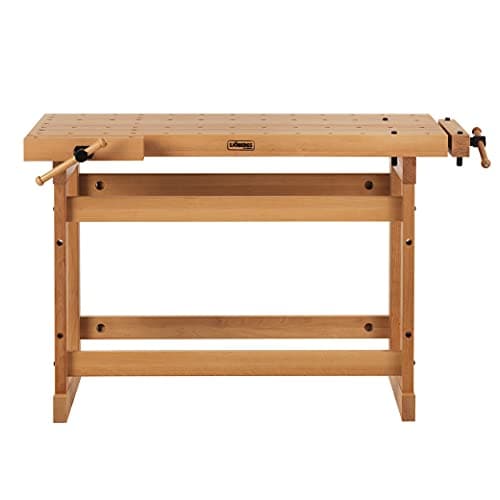
| Sjöbergs Nordic Pro 1400 | 35-7/16 in. | Fixed joiner's bench | Solid beech, 56 × 25 in. top, front and tail vise, 3/4 in. dog holes |
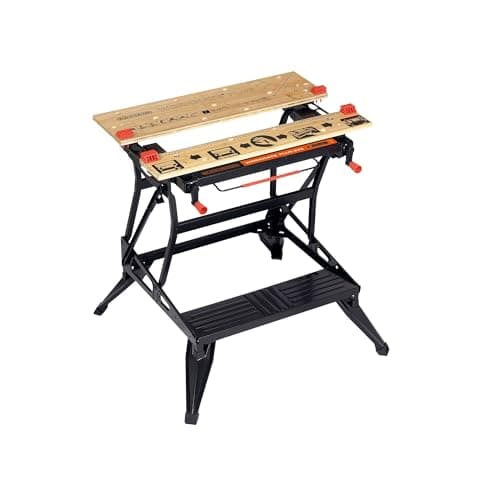
| Black+Decker Workmate 825 | Two working heights | Folding, clamping top | Vise-style clamping top, folding steel frame, swivel pegs |
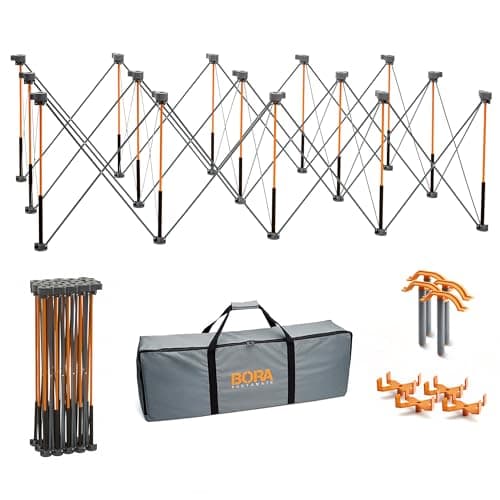
| Bora Centipede | Not published | Folding support grid | 4 × 8 ft support area, folds flat, sacrificial-top friendly |
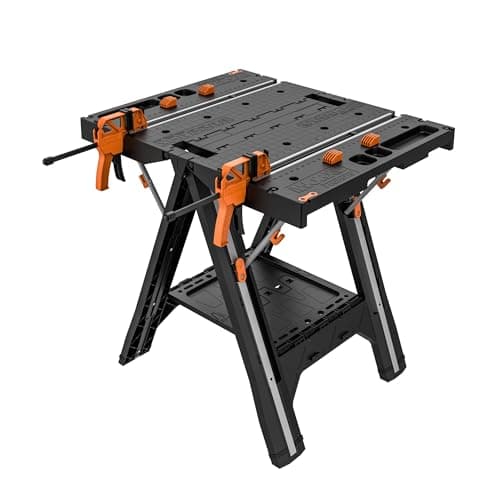
| WORX WX051 Pegasus | Table or sawhorse mode | Folding 2-in-1 | Clamps included, light, folds to a sawhorse |
Why 35-7/16 in. is a revealing number
That is the Sjöbergs bench's published top height, and it is a metric dimension in disguise — 900 mm, the European standard working height. It sits at the upper end of the general bench-work band, which tells you what the makers assume: a bench used for a mixture of hand work and assembly rather than for planing all day.
It is a sane default if you have no strong preference, and it is a couple of inches high if you are a dedicated hand-tool woodworker. The fact that a bench this considered lands there is a reasonable argument against overthinking the number.
Two heights beat one, if you can have them
The folding benches above publish multiple working positions, and that is genuinely useful rather than a compromise. A low position for sawing — where you want the cut near knee height and your weight over it — and a higher position for assembly covers two jobs one fixed bench cannot.
That is also the practical argument for a main bench at your wrist height plus a cheap folding bench at whatever height suits the other job, rather than one compromise bench between the two.
Length and depth, since you are measuring anyway
Two rules of thumb worth knowing while the tape is out. Depth:around 24 in. is the sweet spot — deep enough to hold a wide panel, shallow enough to reach across without leaning on the work. Deeper benches become shelves in the middle. Length: as long as the space allows, because the cost of a long bench is floor area and the benefit is being able to clamp a door or a tabletop.
If you are planning around a small shop, the layout question matters more than any of these dimensions, and the small shop setup guide works through it properly.
Where these numbers come from
The Sjöbergs top height, bench dimensions, materials, vise configurations, dog hole sizes, support areas and folding arrangements above are the manufacturers' own published listing specifications, cited per bench in Sources. The height bands by task and the wrist-crease rule are conventional bench-building practice, given as guidance rather than measurement — we have not run ergonomic trials, we do not have a lab, and our methodology page says so in those words. Prices come from the live price feed.