A table saw blade is a fan. It throws most of the waste down into the cabinet and flings a plume of the finest dust up through the throat plate, straight into the air you are breathing over the cut. A single port under the cabinet catches the first and none of the second, which is why saws with “dust collection” still coat the shop.
Dealing with both takes two separate measures, and they are not equally urgent. The below-blade port handles the volume — the chips and coarse dust that otherwise fill the cabinet and eventually the motor. The over-arm collection handles the hazard: fine airborne dust is what stays in the air for hours and what a respirator exists for.
Below the blade
Cabinet saws and enclosed jobsite saws
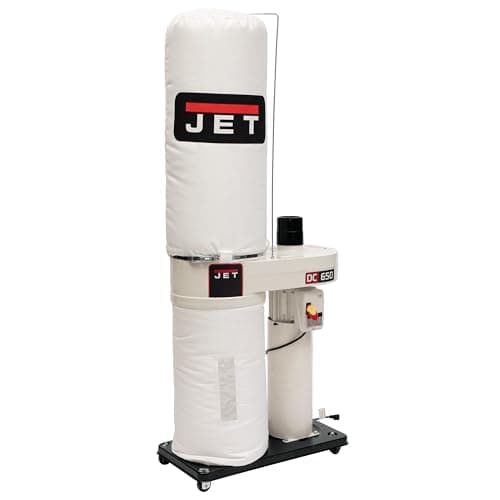
If your saw has an enclosed base with a 4-inch port, connect it to a real dust collector, not a shop vac. The cabinet is a large volume and the port is sized for high flow at low pressure — exactly what a collector delivers and exactly what a vac does not. A vac on a 4-inch port moves almost no air through that volume; you get high suction at a tiny opening and near-zero flow where the dust is.
Inside the cabinet, the enemy is dead space. Chips settle on ledges and in corners rather than finding the port. A sloped baffle or a piece of hardboard angled from the back down to the port turns the cabinet into a funnel and makes a striking difference for the price of a scrap offcut.
Open-frame jobsite saws
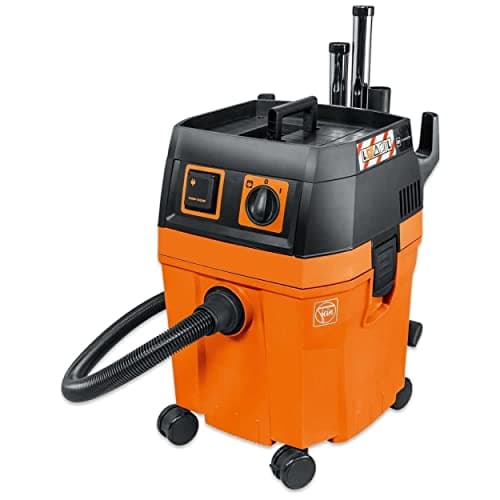
Many jobsite saws have a small port, often 2-1/2 in., feeding an open frame. That port is genuinely designed around a shop vac, and a vac is the right answer here — the volume is small and the port is small, so high suction at low flow works.
If your saw has no port at all, a shop-made plywood or cardboard shroud under the blade with a hose fitting cut into it catches a surprising amount for an hour's work. It will not be tidy. It will be far better than nothing.
Above the blade
This is the part most shops skip and the part that matters most for your lungs. An over-arm blade guard with a dust port sits directly above the cut and catches the fine plume as it leaves the blade. It also happens to be a blade guard, which is a second reason to fit one.
Over-arm guards mount either to the fence rail or on a floor-standing arm. Both work; the floor arm swings clear more easily for non-through cuts. Either way, run it on the same collector as the cabinet with a wye and a length of hose, or on its own vac if you would rather not split the flow.
The one job an over-arm guard cannot do is a non-through cut — dadoes, rebates, tenon cheeks — because the guard has to come off. Those are the cuts where wearing a respirator genuinely matters.
Protect the collector: put a separator in front of it
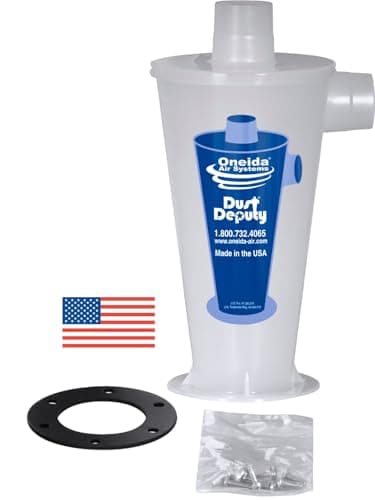
A table saw produces a large volume of chips, and chips are what fill a collector bag and blind a filter. A cyclone separator ahead of the collector drops the heavy material into a bin before it reaches the filter, so the collector keeps its airflow and you empty a bin instead of wrestling a bag. On a machine this productive it is close to essential.
The details that quietly cost you airflow
Flex hose. Corrugated flex hose has several times the resistance of smooth pipe. Use the shortest run you can, and keep permanent runs in smooth pipe — the reasoning is laid out in our ducting guide.
Blast gates. Every open branch steals air from the one you are using. Close every gate except the machine running.
Reducers.Stepping a 4-inch line down to 2-1/2 in. at the saw throttles the whole system to the small pipe's capacity. Keep the full diameter as close to the machine as you can.
The filter. A clogged bag or filter costs you more airflow than any duct mistake. Clean it on a schedule, not when you notice a problem.
What is left in the air
Even a well-collected table saw releases some fine dust, and that is where an air filtration unit comes in — it does nothing at the machine but scrubs the room afterwards. Run it during the session and for a while after you finish, because the finest particles stay airborne long after you have swept up. Our CFM guide covers how to size the collector itself.
What we could not verify
We have not measured capture rates at the blade on specific saws. Port sizes and collector ratings come from the manufacturers' current listings; the reasoning about flow versus suction, dead space and the upward plume is how the machine and the airflow behave.