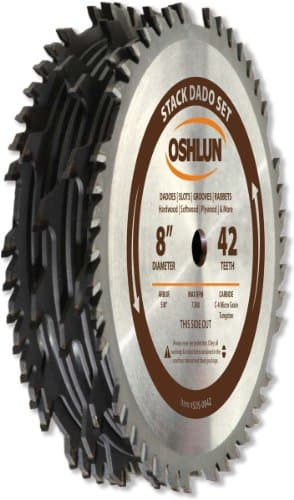
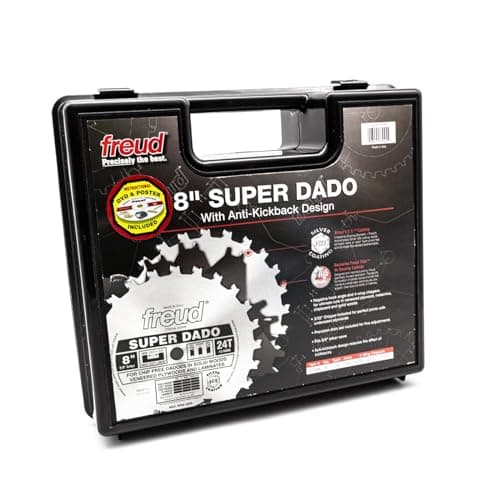
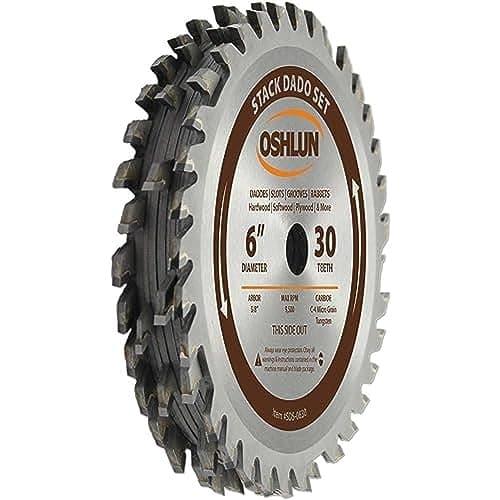
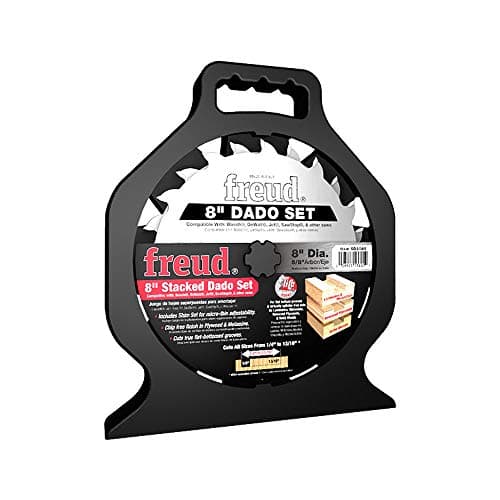
Buy the Freud SD208S Pro Dado if you want the straightforward answer, and the Oshlun SDS-0842 if you want the most set for the money. The Freud publishes a 1/4 to 7/8 in range with three chippers, spacers and a shim set, in the same TiCo carbide Freud puts on its industrial blades. The Oshlun publishes 42 teeth per outside saw against the Freud's 12, six full-body chippers and a wider 1/4 to 29/32 in range — more capability per dollar, at the cost of a stack that takes longer to assemble. If your saw is a benchtop model, skip to the Oshlun SDS-0630, which is the 6 in version of the same set.
Before any of that: check your arbor. A full-width dado stack is roughly 13/16 in of steel and carbide, and it needs enough exposed arbor thread for the nut to engage properly. Plenty of benchtop and jobsite saws do not have it, and some are not rated for a dado stack at all. Your owner's manual is the authority on that, not a review page. The check costs nothing and it is the difference between a useful purchase and a boxed set you cannot mount.
What a dado stack actually is
A stacked dado set is two outside blades with flat-ground or negative-hook teeth, plus a set of chippers that sit between them, plus shims and spacers. You assemble the sandwich to the width you want, bolt it on, and one pass cuts a flat-bottomed groove at that width.
The outside blades do the shoulders — the vertical walls of the groove — and the chippers clear the waste in the middle. That division explains almost every specification difference between the sets below. Tooth count on the outside blades decides how clean the shoulders are, which is what you see on a finished piece. Chipper count and shim resolution decide how precisely you can hit a width, which is what decides whether the shelf fits.
The alternative to a stack is a wobbledado — a single blade mounted on an angled hub, swept to width. They are cheaper and they set up faster, and they cut a groove with a slightly dished bottom because the blade is tilted. We have not ranked one here. On a joint you can see, the dish matters; on a joint you cannot, the extra money for a stack still buys you shoulders that do not need cleaning up.
The criteria, in the order they matter
- Published width range. This is the specification to read first, because it is a hard limit. 13/16 in, 7/8 in and 29/32 in are all common top ends, and the difference decides whether a nominal 1 in groove is one pass or two. All six sets here start at 1/4 in; none of them cuts the 1/8 in groove a small drawer bottom sometimes wants.
- Shim resolution.Plywood is not the thickness it claims — nominal 3/4 in sheet goods routinely measure 23/32 in or less. Shims are how you tune the stack to the board you actually own. Freud rates the SD508 shim set in 0.004 in steps; the cheaper sets include shims without publishing an increment.
- Tooth count on the outside blades. 12 teeth is coarse and fine in solid wood. 24 and 42 teeth cost more and earn it in melamine and veneered plywood, where a coarse tooth lifts the face veneer at the shoulder.
- Chipper design and count. Full-body chippers sit flat against their neighbors; hub-style chippers can rock. More chippers means more widths reached by stacking rather than by shimming, which is faster and more repeatable.
- Diameter your saw can actually turn. An 8 in stack at full width is a real load. On a 15 A benchtop saw a 6 in set is not a downgrade, it is the version that finishes the cut.
Why this page is in the joinery hub and not with the blades
Because a dado stack is not a cutting blade, it is a joint-making cutter. Everything it does — dados for shelves, grooves for drawer bottoms and panel backs, rabbets against a sacrificial fence, tenon cheeks with the stock on end — is joinery. Our table saw blade roundup is the page for ripping and crosscutting; this is the page for cutting the housed joints that hold a cabinet together. If you are not yet sure which joint you want, wood joint types explained covers where a dado beats a butt joint and where it does not.
Prices below come from our live price feed and carry the date they were pulled. Dado sets sit at wildly different prices for similar-looking boxes, so the current number matters more here than in most categories.
The six side by side
Published manufacturer specifications for the six sets ranked above. Width range and tooth count are the two columns that decide most purchases.
| Set | Diameter / teeth | Published width range | Chippers | Max RPM |
|---|
| Freud SD208S Pro Dado | 8 in / 12T | 1/4–7/8 in | 3 x 1/8 in, 3 spacers, shims | 6,000 |
| Oshlun SDS-0842 | 8 in / 42T | 1/4–29/32 in | 6 full-body, steel shims | 9,500 |
| Freud SD508 Super Dado | 8 in / 24T | 1/4–29/32 in | 6, shims in 0.004 in steps | Not published |
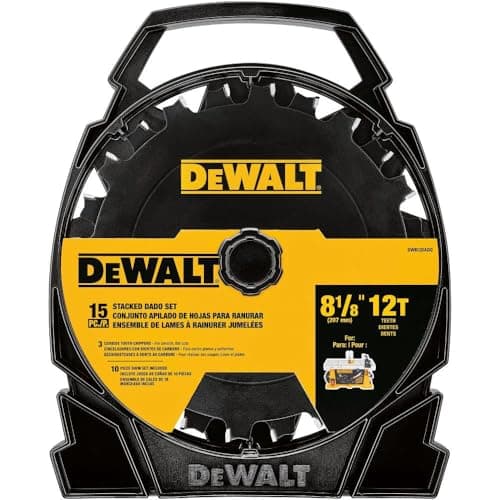
| DeWalt DW812DADO | 12T (8-1/8 in plate) | 1/4–7/8 in | 3 chippers, 3 spacers, 7 shims | Not published |
| Diablo stacked dado | 8 in / 12T | 1/4–13/16 in | 3 two-wing, 1 shim set | 9,000 |
| Oshlun SDS-0630 | 6 in / 30T | 1/4–29/32 in | 6 full-body, steel shims | Not published |
The plywood thickness problem, which is the whole reason shims exist
Nominal 3/4 in plywood is not 3/4 in. Most domestic sheet goods run under the nominal number, and imported ply is often metric — 18 mm is about 23/32 in, which is a full 1/32 in thinner than the groove a 3/4 in setting cuts. A shelf in a 3/4 in dado when the shelf is 23/32 in has a 1/32 in gap, and that gap is visible, unglued and the reason the carcase racks.
So the procedure is always the same, whichever set you buy. Measure the actual board with a caliper. Assemble the stack to the nearest width underthat measurement. Add shims until a test cut in scrap takes the board with firm hand pressure and no hammer. Then cut the real joint. The shim set is not an accessory in this category — it is the part that makes the rest of the box useful, which is why a set that publishes its shim increment (the SD508 at 0.004 in) is worth more than the number of teeth alone suggests.
Zero-clearance throat plate: not optional
A stock throat plate has a slot sized for a single thin-kerf blade. A dado stack will not fit through it, and forcing the issue destroys the plate and possibly more than that. You need a dado-specific insert, either the one your saw manufacturer sells or a blank you cut yourself by raising the stack through it with the blade guard removed and the workpiece clamped.
Cutting your own has a second benefit: it is zero-clearance by definition, so the shoulders of the groove are supported right up to the cut, and tear-out on the underside of plywood largely disappears. Budget for one insert per stack width you use often. It is the cheapest quality improvement in this whole page.
Guard off means a different kind of care
A dado is a non-through cut, so the blade never comes out of the top of the workpiece, so the guard and the riving knife both have to come off. That removes two of the things that normally stop a kickback, and it is worth being deliberate about what replaces them: featherboards to keep the stock against the fence, a push block rather than fingers, and a habit of putting the guard back on the moment the dado work is done rather than at the end of the day.
It also means dust extraction gets worse, because an under-table port cannot catch chips that never leave the top of the board. Our table saw dust collection guide covers why an over-arm guard and an under-table port do different jobs, and why non-through cuts are the case where the over-arm one is missed most.
The three other joints a dado stack cuts
The groove is the headline, but it is not most of the value. Once the stack is on the arbor, three more joints become quick:
Rabbets. Set the stack narrower than the rabbet, bury part of it in a sacrificial face clamped to the rip fence, and one pass cuts a clean rabbet along an edge or across an end. This is how drawer bottoms, cabinet backs and glass rebates get cut, and it is faster and more repeatable than nibbling with a standard blade.
Tenon cheeks. With the stock on end against a tall fence or a tenoning jig, a wide stack removes a cheek in one or two passes rather than in eight. The shoulders come off with the same setting, so both faces of the tenon end up parallel by construction rather than by care. Our mortise and tenon guide covers where that fits in the sequence, and benchtop mortisers cover the other half of the joint.
Half-laps and lap joints.Half the stock thickness, full stack width, multiple passes with the work against a miter gauge and a stop — a jig-free way to cut the joint that frames shop furniture and door grids. A miter gauge with a stop is what makes the repeat passes land in the same place.
When a router is the better answer
A dado stack wins on repetition and on long grooves along a board. A router with a straight bit wins on stopped dados, on cuts in a panel already glued into a carcase, on anything too big to push across a table saw, and on a shop where mounting and un-mounting a stack for one joint is most of the work.
Honestly: if you cut two dados a year, a straight bit and a clamped straightedge is the right tool and the money is better spent elsewhere. Our router bit roundup covers the straight bits that do this, and router bit types explained covers why a 1/2 in shank matters for a groove of any depth. The dado stack earns its place the day you are cutting the same groove in fourteen shelf sides.
Where these numbers come from
The diameters, tooth counts, published width ranges, chipper configurations, shim increments and maximum RPM figures above are the manufacturers' own published specifications, taken from DeWalt's product page and the live retail listings for each set, and cited per set in Sources. Where a manufacturer does not publish a figure — maximum RPM on three of the six sets — the table says so rather than filling the gap. We have not measured runout, groove-bottom flatness or shoulder quality in a lab; we do not have one, and our methodology page says so plainly. Prices come from the live price feed and carry the date they were pulled.