Skip to content
Dovetail & Dust

HUB 03 · Dust Collection

The Best Air Filtration System for a Wood Shop

Ranked against the only number that matters: how many times an hour the unit can turn over the air in your actual shop.

By Stephen V.Updated How we research
#ad

We earn a commission when you buy through our Amazon links, at no extra cost to you. It never changes our rankings, and we say so when the cheaper tool is the better buy. How this works.

An ambient air filter does not replace dust collection — it cleans up after it. Capture at the tool grabs chips and coarse dust; the fine fraction that escapes stays airborne for hours, and that is what a hanging air filter is for. Get the order right and both make sense. Get it wrong and you have bought an expensive fan.

Here is the arithmetic that sizes one, and it is simple enough to do in your head. Multiply your shop's length by its width by its ceiling height to get the volume in cubic feet. A one-car garage at roughly 12 × 22 feet with an 8-foot ceiling is about 2,100 cubic feet. To turn that air over six times an hour — a commonly cited target for a working shop — you need about 12,600 cubic feet per hour, which is 210 CFM.

Now compare that with the published ratings: the WEN 3410 tops out at 400 CFM, the POWERTEC AF1045 at 1,060, the JET AFS-1000C at 1,000. So a one-car garage is comfortably served by the cheapest unit here. A two-car garage at roughly 22 × 22 × 8 feet is about 3,900 cubic feet, needing around 390 CFM for six air changes — right at the WEN's ceiling, and comfortable territory for the POWERTEC or the JET. That calculation is the entire buying decision, and it is why this roundup has three picks rather than eight.

Two caveats on that math. First, a filter's rated CFM is measured at its highest speed, which is also its loudest — most people run these on medium, so build in headroom. Second, air changes assume the air actually circulates. A unit hung in a corner behind a cabinet moves the same volume on paper and far less in practice; hang it where the air can loop around the shop, ideally along the long axis and not directly over your head.

Finally, the honest ranking note: we have three picks here, not five. Two of the units we searched for came back as filter replacements rather than machines, and we would rather publish three real options than pad the list with an accessory dressed up as a pick. Everything below is a complete, currently purchasable filtration unit.

The short answer

Quick picks

#ProductBest forScorePrice
01
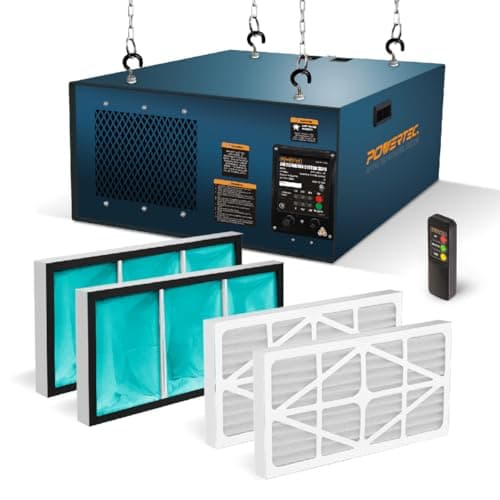
POWERTEC POWERTEC AF1045 3-Speed Air Filtration System
POWERTEC AF1045 3-Speed Air Filtration System

The most airflow per dollar here. A published 655/875/1,060 CFM across three speeds, with a spare set of inner and outer filters in the box — the practical pick for a two-car shop.

Best for a two-car shop
8.0
$369.99Amazon
02
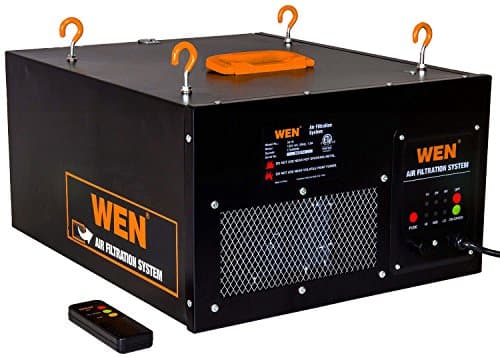
WEN WEN 3410 3-Speed Air Filtration System
WEN 3410 3-Speed Air Filtration System

The one that makes air filtration affordable. Three published speeds from 300 to 400 CFM with an RF remote, which is enough to turn over the air in a single-car garage several times an hour.

Best value
7.4
$144.39Amazon
03
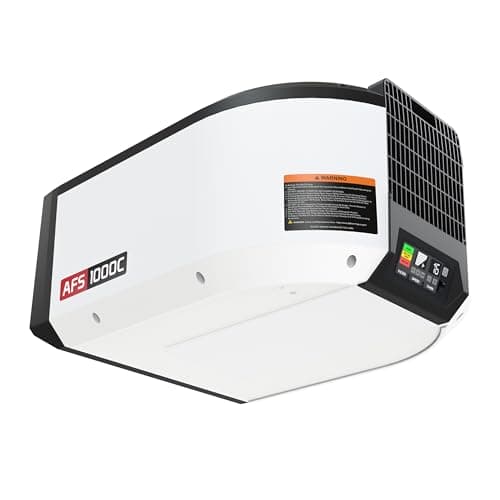
JET JET AFS-1000C Air Filtration System
JET AFS-1000C Air Filtration System

The shop-grade unit. A published 1,000 CFM through a 1-micron filter, with the build quality and parts support that make it a twenty-year purchase rather than a five-year one.

Best build quality
8.0
$659.99Amazon

#ad · Live prices from the Amazon Product API, as of Sep 1, 2026. Where we have no verified live price, we show none — we would rather leave a gap than print a number that has rotted.

In detail

The picks, in full

01
POWERTEC POWERTEC AF1045 3-Speed Air Filtration System

Best for a two-car shop

POWERTEC AF1045 3-Speed Air Filtration System

655/875/1,060 CFM3 speedsRemoteSpare filters incl.
8.0/10

The most airflow per dollar here. A published 655/875/1,060 CFM across three speeds, with a spare set of inner and outer filters in the box — the practical pick for a two-car shop.

Airflow
9
Filtration
8
Noise
6
Build
8
Value
9

Pros

  • 1,060 CFM published top speed covers a two-car garage properly
  • Spare inner and outer filters included, which is a real cost saved in year one
  • Remote control and timer, like the shop-grade units

Cons

  • Bigger and heavier to hang than the WEN — check your joists
  • Loud at top speed; most people run it on medium

Don't buy this if…

your shop is a corner of a single garage bay. You are buying airflow you cannot use.

$369.99View on Amazon

Price as of Sep 1, 2026. Prices change — Amazon's is the one that counts.

#ad · we may earn a commission from this link to POWERTEC AF1045 3-Speed Air Filtration System

02
WEN WEN 3410 3-Speed Air Filtration System

Best value

WEN 3410 3-Speed Air Filtration System

300/350/400 CFM3 speedsRF remoteCeiling hung
7.4/10

The one that makes air filtration affordable. Three published speeds from 300 to 400 CFM with an RF remote, which is enough to turn over the air in a single-car garage several times an hour.

Airflow
6
Filtration
7
Noise
7
Build
7
Value
10

Pros

  • Costs a fraction of the shop-grade units and does the same basic job in a small space
  • RF remote means you never climb to change the speed
  • Light enough to hang from a garage ceiling joist without reinforcement

Cons

  • 400 CFM at top speed is too little for a two-car shop
  • Filters are a consumable — factor replacements into the running cost

Don't buy this if…

your shop is over about 400 square feet. Undersizing an air cleaner just moves dust around slowly.

$144.39View on Amazon

$151.995% off

Price as of Sep 1, 2026. Prices change — Amazon's is the one that counts.

#ad · we may earn a commission from this link to WEN 3410 3-Speed Air Filtration System

03
JET JET AFS-1000C Air Filtration System

Best build quality

JET AFS-1000C Air Filtration System

1,000 CFM1-micron filter120 VRemote + timer
8.0/10

The shop-grade unit. A published 1,000 CFM through a 1-micron filter, with the build quality and parts support that make it a twenty-year purchase rather than a five-year one.

Airflow
9
Filtration
9
Noise
7
Build
9
Value
6

Pros

  • 1-micron filter rating is finer than most hobby units publish
  • Metal cabinet and serviceable motor — JET parts are available years later
  • Timer lets you leave it running after you switch the lights off, which is when it matters most

Cons

  • Costs three to four times the WEN for a similar airflow class to the POWERTEC
  • Heavy — hanging it is a two-person job

Don't buy this if…

you want the cheapest route to cleaner shop air. The WEN does the basic job for a quarter of the price.

$659.99View on Amazon

Price as of Sep 1, 2026. Prices change — Amazon's is the one that counts.

#ad · we may earn a commission from this link to JET AFS-1000C Air Filtration System

Sizing an air filter properly

Step 1 — shop volume

Length × width × ceiling height, in feet. Do not subtract for benches and machines; the air still occupies the room.

Step 2 — air changes per hour

Six changes an hour is a commonly used target for an active shop; eight is better if you sand a lot. Multiply your volume by the number of changes to get cubic feet per hour, then divide by 60 to get CFM. A 2,100 cubic foot garage × 6 changes ÷ 60 = 210 CFM.

Step 3 — build in headroom

Published CFM figures are top-speed figures, and the top speed is the loudest. Aim for a unit whose medium speed roughly meets your target, so the machine is pleasant to run continuously rather than something you switch off.

Filtration ratings, and what to ignore

These units use two filters: an outer pre-filter that catches coarse dust and an inner filter that catches the fine fraction. The number that matters is the inner filter's micron rating — the JET publishes 1 micron, which is finer than most hobby units state. Marketing that quotes an efficiency percentage without a particle size is telling you nothing; efficiency is always at some particle size.

Filters are a running cost

Both filters load up and need cleaning or replacing on a schedule — this is the ongoing cost of owning one, and it is why the POWERTEC including a spare set of both filters genuinely matters in year one. Vacuum the pre-filter regularly; replace the inner filter when airflow visibly drops.

How to actually use one

The single most valuable habit: leave it running after you stop working. The finest dust stays airborne for a long time after the tools go quiet, and it settles on every surface overnight if the filter is off. Every unit here has a timer for exactly this reason — set it for an hour or two and walk away.

Placement

Hang it so the air loops around the shop rather than short-circuiting from outlet straight back to inlet. Along the long wall, blowing down the length of the shop, is the usual arrangement. Avoid hanging it directly over the bench where you sand — you want it pulling dust away from you, not down through your breathing zone.

What an air filter does not do

It does not protect you while you are making the dust. Air filtration is a background process working on the whole room over minutes and hours; the cloud around a sander is immediate and concentrated. That is what capture at the tool and a respirator are for. Think of the three as layers: capture at the source, filter the room, protect your lungs.

What we could not verify

We have not measured airflow or particle counts for these units. CFM figures, micron ratings, speed counts and included accessories are the manufacturers' published specifications. The air-change arithmetic above is straightforward math applied to those published figures, shown so you can reproduce it for your own shop.
How we picked

We do not run a testing lab

We researched published manufacturer specifications, manuals and spec sheets, ran the arithmetic those specs support, and read owner reviews at volume, then scored each tool against a published rubric. The scores are judgments from documented research — they are not measurements we took, because we do not have a lab and we are not going to pretend we do. Where a number came from a manufacturer's document, we name it and link it in Sources.

Questions

Frequently asked

What CFM air filter do I need for my shop?
Work out shop volume (length × width × height), multiply by six air changes an hour, and divide by 60. A 2,100 cubic foot one-car garage needs about 210 CFM; a 3,900 cubic foot two-car garage needs about 390 CFM. Then buy a unit whose middle speed meets that figure, so you can run it without the noise.
Does an air filter replace a dust collector?
No. They do different jobs. A dust collector captures chips and coarse dust at the machine before it becomes airborne. An air filter cleans the fine dust that escaped and is now floating in the room. A shop that cares about its air wants both, in that order.
Where should I hang an air filtration system?
Where the air can circulate in a loop rather than short-circuit from outlet back to inlet — typically along the long wall, blowing down the length of the shop. Avoid hanging it directly above where you sand, so it pulls dust away from you rather than through your breathing zone.
How long should I leave an air filter running?
At least an hour or two after you finish working, which is what the built-in timers are for. Fine dust stays airborne long after the tools stop, and switching the filter off with the lights simply lets it settle on every surface instead.

Keep reading

Receipts

Sources

We do not run a testing lab, and we do not pretend to. Our picks come from published manufacturer specifications and manuals, the arithmetic those specs support, and owner reviews read at volume. Where we could not verify something, we say so on the page rather than quietly leaving it out. Read our full method.