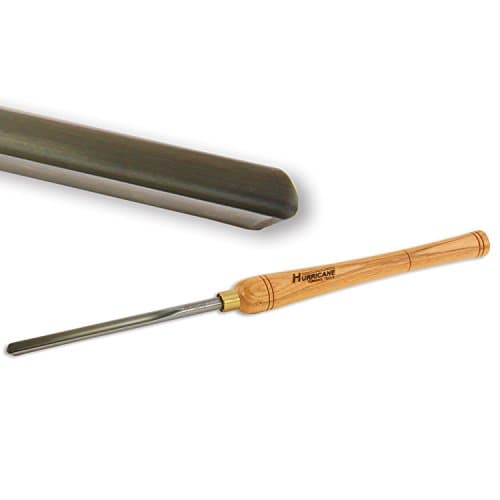
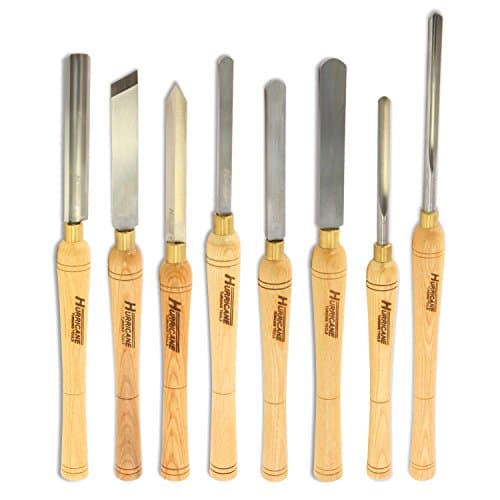
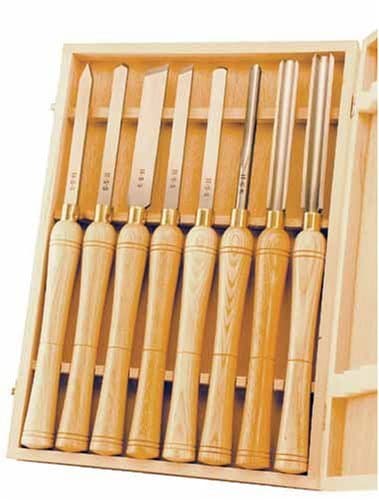
Buy the PSI Woodworking LCHSS8 eight-piece set, use it until you know which three tools you actually reach for, then replace those three with long-handled tools. That is the cheapest honest path into turning, and it is cheaper than the mistake most people make, which is buying a premium set of eight when they will only ever use four of them. If you already own a starter set, the single purchase that changes your turning is the Hurricane HTT-101 bowl gouge— the same 1/2 in. flute on a 15 in. handle instead of a 10 in. one.
Two specifications decide everything: the steel and the handle
Everything else on a turning-tool box is marketing. These two are not.
High speed steel, not carbon steel.A turning tool cuts at the periphery of a workpiece spinning at hundreds or thousands of RPM, and it gets hot — hot enough to turn the edge blue if you lean into a cut or grind carelessly. Carbon steel that reaches that temperature is permanently softened: the edge will never hold again, and no amount of resharpening brings it back. High speed steel, usually M2, keeps its hardness at those temperatures. Every tool on this page is HSS or carbide for that reason, and a cheap set advertised only as "carbon steel" or "chrome vanadium" is a set you will ruin learning on.
Handle length is leverage, and leverage is control.This is the part nobody explains, so: the tool rest is a fulcrum. The wood pushes on the edge at one end of the lever and your hands resist at the other. A catch happens when the wood grabs the edge and rotates the tool about that fulcrum faster than your grip can stop it. Lengthen the handle and you lengthen the resisting arm — the same force at the edge produces less rotation, and you feel the cut starting to go wrong in time to back off.
A budget set has 10 in. handles because they are cheaper to make and they fit in a smaller box. Premium bowl gouges come on 15 to 16 in. handles because that is what the job needs: the handle goes under your forearm and against your side, and your body becomes part of the lever. If you buy one upgrade in your first year of turning, buy handle length.
The four tools that do almost all the work
An eight-piece set is a good way to find out which four you need. They are:
A spindle roughing gouge turns a square blank round between centers. It is a wide, deep, U-shaped flute and it removes material faster than anything else in the rack. A bowl gouge hollows and shapes a bowl; deep flute, thick wall, usually swept back. A spindle gouge cuts the beads, coves and details on a spindle; shallow flute, fingernail grind. A parting tool separates the finished piece from the waste and sizes tenons on the way.
Scrapers and skews are the next tier. A round-nose scraper fairs the inside of a bowl and rescues a surface a gouge has torn; a skew produces the finest finish of any tool on a spindle and is also the hardest tool in turning to learn. Both are in the sets here, and neither is a tool to buy on its own first.
A safety rule that is not optional
Never use a spindle roughing gouge on a bowl. This is the one place where a turning tool can fail structurally rather than just cut badly. A spindle roughing gouge is made from rolled steel with a narrow tang pushed into the handle, and it is designed for a continuous cut along the grain between centers. A bowl presents the grain twice per revolution, in an interrupted cut, and the shock loading on that narrow tang is exactly what it was not designed for. Tangs do snap, and the tool leaves at speed.
A bowl gouge is machined from round bar and the flute runs into the handle as a continuous shaft, which is why it survives that duty. The tools look superficially similar in a rack and they are not interchangeable. Our wood lathe roundup covers the machine side of the same question.
Carbide changes the trade, it does not remove it
A carbide tool like the Easy Wood Tools Easy Finisher carries a small replaceable cutter on a square bar. There is no bevel to ride, no grinder, no learning to sharpen; when the cutter dulls you loosen a screw, rotate it to a fresh edge, and carry on. Presented flat on the rest with the bar horizontal, it is also much harder to catch than a gouge held at the wrong angle. For somebody who wants to make a pen or a small bowl this weekend, it is genuinely the fastest route to shavings.
What it costs you is real and worth stating plainly. A carbide cutter scrapes; a gouge riding its bevel slices. The sliced surface comes off the tool ready to finish, and the scraped one needs sanding, particularly in figured wood where scraping tears out the grain. The cutters are also a permanent consumable, where a gouge costs you nothing but grinder time for a decade. Buy carbide to start turning. Learn a gouge if you want to turn well.
Sharpening is part of owning these, not an optional extra
Turning tools get resharpened more often than any other tool in a woodshop — several times within a single bowl, not once a month. That is normal and it is designed in: you touch the bevel to a grinder wheel for a few seconds and go back to the lathe. It also means two things when you are buying.
First, a grinder and a way to hold a repeatable bevel angle are part of the cost of turning, not an accessory. Our sharpening systems roundup covers the machines, and the principle behind a repeatable bevel is the same one in how to sharpen chisels.
Second, it is an argument for cheap tools while you are learning. You will reshape a grind, get it wrong, and grind away a quarter of an inch of steel finding out. Do that on a budget HSS gouge rather than on a Sheffield one.
What the set price is really telling you
There are three price tiers in turning tools and the boundaries are sharp. A budget HSS set of eight costs roughly what one premium gouge costs; the steel is genuinely M2, the handles are short and the grinds are approximate. A mid-tier set of eight costs about four times that and buys per-tool handle lengths and better finishing. A single premium tool — Sheffield or Swiss — costs somewhere in between the two sets and arrives ground to a usable shape by somebody who turns.
The trap is the middle: paying mid-tier money for a set of eight when four of them will sit in the rack forever. Buy at the bottom to find out what you use, then buy single tools at the top.
One clarification, because the words overlap: a turning gouge and a carving gougeare not the same tool. A turning gouge is a long-handled lever presented to wood that is moving; a carving gouge is a short tool presented to wood that is still, and its edge is a sweep rather than a flute. Neither does the other's job. Prices below come from our live price feed and carry the date they were pulled.
The six side by side
Published manufacturer and retailer specifications for the six tools ranked above. The handle column is the one to read first.
| Tool | Steel | Size | Handle |
|---|
| PSI Woodworking LCHSS8 (8 pc) | M2 HSS | 8 tools, 3/16 in. to 1 in. | 10 in. |
| Hurricane HTT-101 bowl gouge | M2 HSS | 1/2 in. bar, 3/8 in. flute | 15 in. |
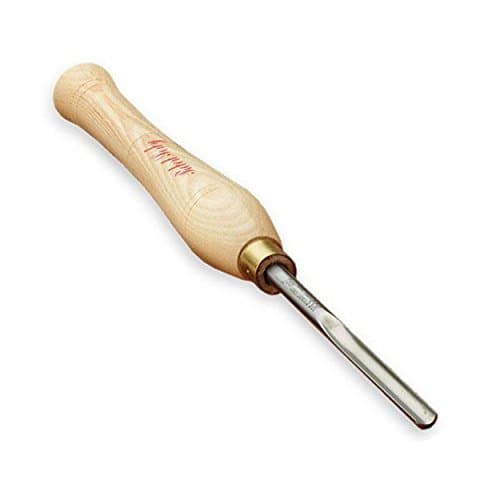
| Robert Sorby 840H spindle gouge | HSS | 3/8 in. (10 mm) | 10 in., 16-1/2 in. overall |
| Easy Wood Tools 6300 Easy Finisher | Replaceable Ci3 carbide | 3/8 in. square bar | 14 in., 21 in. overall |
| Hurricane 8-Piece Starter Set | HSS | 8 tools, 1/2 in. to 1 in. | Per tool, to 16 in. |
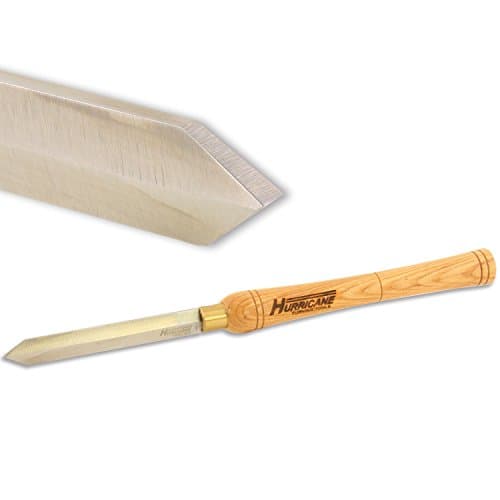
| Hurricane HTT-113 parting tool | HSS | 3/4 in. x 3/16 in. diamond | Not published |
Which tool for which cut
| What you are doing | The tool | Why that one |
|---|
| Making a square blank round between centers | Spindle roughing gouge | A wide, deep U-flute removes waste faster than anything else — spindles only |
| Hollowing and shaping a bowl | Bowl gouge, 1/2 in. | Machined from round bar, so it survives an interrupted cross-grain cut |
| Beads, coves and spindle detail | Spindle gouge, 3/8 in. | Shallow flute rides the bevel on a convex surface where a bowl gouge will not |
| Sizing a tenon, parting the piece off | Diamond parting tool | Widest at the edge, so the kerf stays open and the tool does not bind |
| Fairing the inside of a bowl, fixing tearout | Round-nose scraper | Takes a shaving off a surface a gouge cannot reach cleanly |
| Turning a weekend project with no grinder | Carbide finisher | Rotate the cutter instead of sharpening, at the cost of a scraped surface |
Bar diameter, flute width, and the number on the label
Bowl gouges are labelled inconsistently and it causes real confusion. Some makers name the tool by the diameter of the round bar it is machined from, and some name it by the width of the flute ground into that bar. A tool sold as a 1/2 in. bowl gouge may be a 1/2 in. bar with a 3/8 in. flute — which is how the Hurricane HTT-101 is specified, and it is the general-purpose bowl size — or it may be a 5/8 in. bar with a 1/2 in. flute.
When you are comparing two listings, find the flute figure. It is the one that tells you how much wood the tool can move and how tight a curve it can follow inside a bowl. If a listing gives only one number, assume it is the bar.
The lathe speed rule, because it belongs with the tools
Start slow and come up. A large, out-of-round or unbalanced blank at high speed is the most dangerous thing in a home shop, and the lathe will tell you — if the machine is walking across the floor, the speed is wrong, not the tool. Turn the blank round at a speed where the vibration disappears, then increase it for finishing cuts.
Round the blank on a bandsaw before it goes near the lathe if it is a bowl blank. Cutting the corners off a square blank with a band saw takes two minutes and removes most of the interrupted cut that makes roughing a bowl unpleasant.
One more thing that belongs here: a lathe produces more shavings by volume than any other machine in a shop, and almost none of it goes down a dust port — it is thrown in an arc off the tool. The fine dust from sanding on the lathe is the part that matters for your lungs. Our lathe dust collection guide covers where to put a hood so it catches something.
Where these numbers come from
Steel grades, bar and flute sizes, handle lengths and overall lengths are the makers' and retailers' published specifications, cited per tool in Sources: Penn State Industries' own page for the LCHSS8, the retail specification sheets for the Hurricane tools and the Hurricane starter set, retailer listings for the Robert Sorby 840H, and the published specification for the Easy Wood Tools 6300 (3/8 in. square bar, 7 in. bar length, 14 in. maple handle, 21 in. overall, standard round Ci3 cutter).
Four gaps are stated rather than filled. Penn State's own page contradicts itself on the LCHSS8, giving the blade length as 6.5 in. in its specification table and 5-1/4 in. in its description, and the overall length as 16.5 in. in one place and about 16 in. in the other, so both figures are given as published rather than as fact. Hurricane's handle wood is not confirmable— retailer listings say beech in one place and ash in another. Hurricane publishes no length for the HTT-113 parting tool that we could verify. And Robert Sorby publishes the handle length but not the handle wood, so the "ash handle" in the Amazon title is reported as the listing's description rather than as a manufacturer specification.
We have not tested edge life, catch resistance or surface finish in a lab — we do not have one, and our methodology page says so plainly. Prices come from the live price feed and carry the date they were pulled.