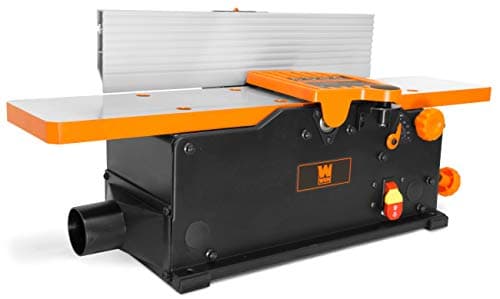
Every benchtop jointer shares one limitation, and it is not the motor: the beds are short. A jointer flattens a board by referencing the part already flattened, so bed length sets the longest board you can straighten reliably. Roughly, a benchtop jointer handles stock up to about twice its total bed length before accuracy falls away. Know that number and everything else about this category makes sense.
What a jointer does is create the first flat face and the first square edge on a rough board. Without one, a thickness planerwill happily plane a cupped board to a uniform thickness and hand you back a thinner cupped board — because the planer references the face on the bed, whatever shape it is. The jointer creates the reference; the planer copies it. That order is not optional, and it is why jointer vs planer is the first thing to read if you are buying either.
The second decision is the cutterhead. Straight knives are cheap and cut cleanly in cooperative grain, but they tear out figured or reversing grain and resetting them is an afternoon of shimming. Spiral and helical heads use small square carbide inserts arranged in a spiral; they shear the fibers rather than chopping them, they are markedly quieter, and when an edge dulls you rotate the insert rather than reset a knife. Every machine in this roundup has a spiral or helical head, because at current prices there is no good reason to buy straight knives on a benchtop jointer.
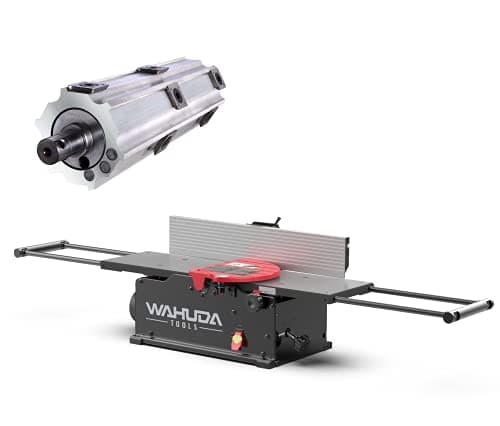
The third is width. Six inches is the standard, and it is enough for the edge jointing that makes up most of a jointer's work. It is not enough to face-joint a 7-inch board, which is the frustration that eventually pushes people to an 8-inch machine like the Wahuda. If your lumber comes rough and wide, buy width. If you mostly buy surfaced stock and need straight edges, six inches is fine forever.
Do you actually need a jointer?
Be honest here, because a jointer is the tool most likely to sit unused in a small shop. You need one if you buy rough-sawn lumber, if your stock arrives cupped or twisted, or if you glue up panels and want joints that close without clamping pressure fighting a gap. You do not need one if you buy pre-surfaced boards from a home center and build with sheet goods — in which case a track saw gives you straight edges for a fraction of the money and floor space.
The alternatives, stated fairly
You can straighten an edge with a router and a straightedge, with a track saw, or with a hand plane. You can flatten a face with a jack plane and winding sticks, or with a planer sled that carries the board on a flat reference. All of these work; all of them are slower per board than a jointer. A jointer buys speed and repeatability, not capability you cannot otherwise have.
How to read the specs
Bed length is the real spec
Total bed length — infeed plus outfeed — is what limits board length. Benchtop jointers run roughly 30 inches total; floor jointers run 55 to 76 inches. That is the entire reason a floor jointer costs and weighs what it does. If you routinely straighten 6-foot boards, no benchtop jointer will satisfy you and the honest advice is to save for a floor machine or use a different method.
Width is a hard ceiling
You cannot face-joint a board wider than the cutterhead. Six inches means six inches. The common workaround — rip a wide board down the middle, joint both halves, glue them back together — works and is what most small-shop woodworkers actually do. The 8-inch Wahuda exists so you do not have to.
Fence quality
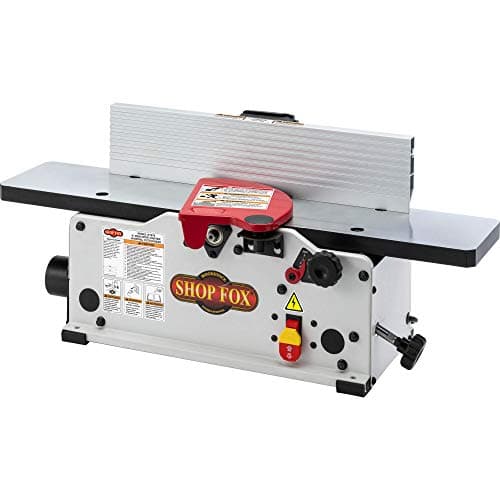
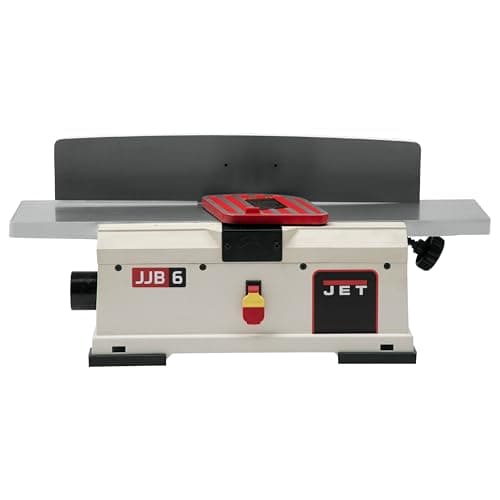
The fence sets the angle between the face and the edge, which is what makes a glue joint close. A fence that does not stay at 90 degrees under a push turns every edge joint into a slight wedge. This is where the heavier machines — the Shop Fox and the JET — earn their premium over the value units.
By shop and budget
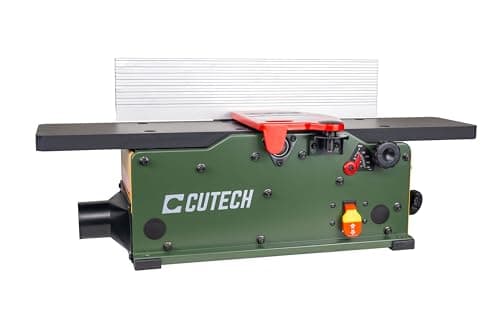
First jointer, tight budget, mostly edge work: the WEN JT630H does the job for the least money. Cut quality is the priority: the Cutech has a long reputation for a good spiral head at a fair price. You keep hitting the 6-inch ceiling: the Wahuda 8-inch, which is the cheapest way to buy width. You want a machine to keep: the Shop Fox W1876 or the JET JJ-6HHBT, where the extra money buys mass, fence rigidity and a helical head with four-sided inserts.
What we could not verify
We have not milled test boards on these five. Widths, motor ratings and cutterhead types are the manufacturers' published specifications. Judgments about fence rigidity and cut quality come from design differences (mass, cutterhead type, table material) and from owner reviews read at volume — not from measurements, because we do not run a lab.