Skip to content
Dovetail & Dust

HUB 02 · Power Tools

Best Belt Sander Under $200

Under two hundred dollars you can have variable speed or a cast-iron benchtop machine, and the choice depends on whether the work comes to the tool.

By Stephen V.Updated How we research
#ad

We earn a commission when you buy through our Amazon links, at no extra cost to you. It never changes our rankings, and we say so when the cheaper tool is the better buy. How this works.

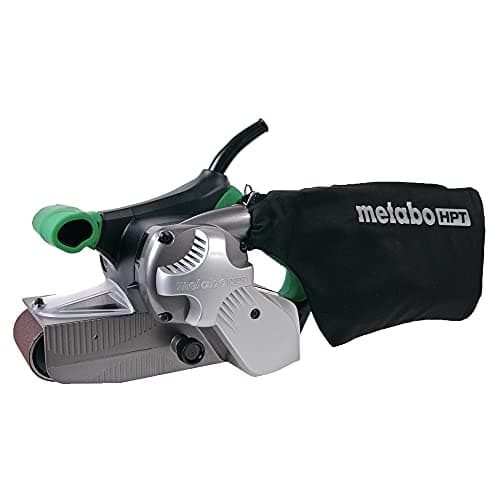
Under $200 the belt sander to buy is the Metabo HPT SB8V2, and the reason is the speed dial. It is for anyone who sands both softwood and veneered sheet: Metabo HPT publishes 820 to 1,475 ft/min on a 9 A motor at 9.5 lb, with a five-year limited warranty, and at the bottom of that range you can ease an edge on plywood without going through the face veneer. The budget pick is the WEN 6321— 7 A, a published 820 ft/min and 6 lb, at about what a box of good belts costs.

If the parts you sand are small enough to carry to a machine, the WEN 6502T benchtop belt-and-disc sander is the better buy than either handheld, and it is also under the cap. Prices come from our live price layer, last checked November 23, 2026, and the cap is applied to that number rather than to a remembered one.

What the $200 cap excludes, and it is one specific thing

It excludes the 4 in. belt. The handheld sanders under this cap are all 3 x 21 in. machines, and the difference between a 3 in. and a 4 in. belt is not refinement — it is a different job.

A 3 in. belt is narrow enough to follow the shape of whatever is under it. On an edge, a door stile or a small part that is exactly what you want. On a glued-up tabletop it is exactly what you do not want: the sander rides the high spots, digs into the low ones and leaves a surface with a gentle trough down the middle that you will see the moment finish goes on. A 4 in. belt bridges across high spots instead of following them, which is why cabinetmakers who flatten panels buy one and why it sits above this cap.

So the cap is not a compromise if your work is edges, doors, small parts and the occasional rough board. It is a real limit if your reason for wanting a belt sander is flattening tabletops, and in that case our belt sander roundup covers the 4 x 24 in. machines honestly, including the one that leads it.

Variable speed is the feature worth paying for in this band

A belt sander is the most destructive tool in a small shop. It removes material faster than anything except a planer, it does it in whatever direction you happen to be pushing, and it has no fence or depth stop to save you. The thing that tames it is a speed dial.

The Metabo HPT SB8V2publishes 820 to 1,475 ft/min, which is the widest range here. At the top of it, the 9 A motor takes a glue line off a hardwood edge in seconds — more motor than most 3 x 21 in. sanders carry, and it shows when you lean on it. At the bottom, it is slow enough to work on plywood edging and thin stock without the tool running away from you. Metabo HPT publishes 87 dB, which is loud enough that hearing protection is not a suggestion, and the left-side dust bag keeps the housing flush on the right so the sander reaches into an inside corner.

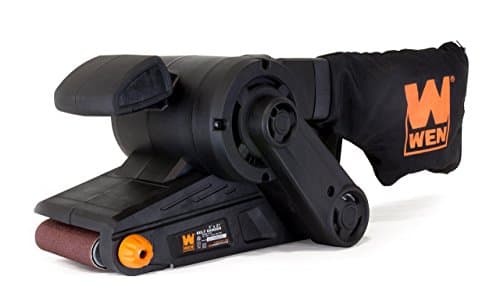
The WEN 6321has one speed and WEN publishes it as 820 ft/min, which is the slow end of the Metabo HPT's range. On a budget tool that is genuinely a feature: a slow belt is harder to do damage with. At a published 6 lb it is the lightest tool here, which makes it the easy one to run on a vertical face or a long edge, and the front roller sits proud of the housing so it sands into a corner from the nose. What you give up is speed when you actually want it, and mass — six pounds has no weight to hold it flat, so it tips and gouges if you lift the tail.

The benchtop machine is the one most small shops should buy

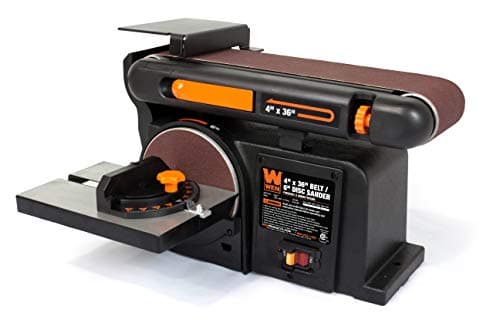
The WEN 6502T is a 4 x 36 in. belt that tilts from horizontal to vertical plus a 6 in. disc with a miter gauge, on a cast-iron base, for less than the mid-price handheld. That is a different proposition from both tools above, and for a lot of woodworking it is a better one.

The reason is that you bring the work to the machine. Small parts, end grain, a mitre that needs truing, a curve that needs fairing — all of those are jobs where a handheld sander means clamping the part down and chasing it, and a stationary sander means holding the part and touching it to the belt. The disc with the included miter gauge trues an end square or to an angle far faster than a block plane. The cast-iron base damps the vibration that makes cheap benchtop sanders walk across the bench. And a stationary sander is the one sanding tool you can genuinely connect to dust collection, because the port does not move.

The limits are equally clear. WEN publishes no belt speed and no weight for it, so you cannot compare it on either figure and neither can we. The 4.3 A motor is small, so leaning on the disc slows it. And it cannot follow you to a tabletop, a door or a built-in — a benchtop sander only works on parts that come to it.

Side by side, as published

SanderAbrasivePublished motor and speedPublished weightWarranty
Metabo HPT SB8V23 x 21 in. belt9 A, 820-1,475 ft/min variable9.5 lb5 years limited
WEN 6502T4 x 36 in. belt + 6 in. disc4.3 A, disc to 3,600 RPM; belt speed not publishedNot published2 years
WEN 63213 x 21 in. belt7 A, 820 ft/min single speed6 lb2 years

Every figure above is the manufacturer's own published number for the exact SKU we link, and the blanks are blanks for a reason: WEN publishes neither a belt speed nor a weight for the 6502T, and no noise figure for either of its sanders. Metabo HPT publishes 87 dB for the SB8V2 and we print it as the company does. We did not weigh a tool, measure a decibel or time a pass — there is no lab here, which the methodology page states plainly.

What to buy, in order

One handheld belt sander for mixed work, where a speed dial earns its money every time you touch plywood: the Metabo HPT SB8V2. Small parts, end grain and mitres, with bench space to spare: the WEN 6502T, and it costs less. The cheapest way to find out whether you need a belt sander at all: the WEN 6321.

One caution worth more than any of them. A belt sander is a stock-removal tool, not a finishing tool, and the surface it leaves always needs a random-orbit sander afterwards — our sander buying order sets out where each machine fits, and grit progression covers what to do after the belt comes off. If your finished surfaces show swirls or scratches, sander swirl marks is the page that diagnoses it.
The short answer

Quick picks

#ProductBest forScorePrice
01
Metabo HPT Metabo HPT SB8V2 3 x 21 in. Variable-Speed Belt Sander
Metabo HPT SB8V2 3 x 21 in. Variable-Speed Belt Sander

The 3 x 21 in. sander with a real speed dial and a real warranty. 820 to 1,475 ft/min on a 9 A motor covers everything from softwood stock removal to a light pass on veneer, and Metabo HPT backs it for five years.

Best value
8.0
$132.04Amazon
02
WEN WEN 6502T 4 x 36 in. Belt and 6 in. Disc Sander
WEN 6502T 4 x 36 in. Belt and 6 in. Disc Sander

The benchtop machine, and the one most small shops should actually buy. A 4 x 36 in. belt that tilts from horizontal to vertical, a 6 in. disc with a miter gauge, and a cast-iron base — for less than a mid-price handheld sander.

Best benchtop
7.8
$110.00Amazon
03
WEN WEN 6321 7 A 3 x 21 in. Belt Sander
WEN 6321 7 A 3 x 21 in. Belt Sander

The cheapest way to find out whether you need a belt sander at all. Six pounds, a 7 A motor, 820 ft/min, a lock-on switch and a dust bag, at a price that makes it the tool you are not afraid to use on rough lumber.

Budget pick
6.4
$38.79Amazon

#ad · Live prices from the Amazon Product API, as of November 23, 2026. Where we have no verified live price, we show none — we would rather leave a gap than print a number that has rotted.

In detail

The picks, in full

01
Metabo HPT Metabo HPT SB8V2 3 x 21 in. Variable-Speed Belt Sander

Best value

Metabo HPT SB8V2 3 x 21 in. Variable-Speed Belt Sander

3 x 21 in. belt9 A, 820-1,475 ft/min9.5 lb5-year limited warranty
8.0/10

The 3 x 21 in. sander with a real speed dial and a real warranty. 820 to 1,475 ft/min on a 9 A motor covers everything from softwood stock removal to a light pass on veneer, and Metabo HPT backs it for five years.

Flattening power
7
Control and tracking
9
Dust and noise
7
Build
8
Value
9

Pros

  • Variable speed is the feature that makes a belt sander safe on thin material — dial down to 820 ft/min and it stops eating through veneer
  • 9 A is more motor than most 3 x 21 in. sanders carry, and it shows when you lean on it in hardwood
  • 9.5 lb is light enough to run on a vertical face or an edge without your shoulder giving out first
  • Left-side dust bag keeps the housing flush on the right, so it sands into an inside corner
  • Five-year limited warranty — the longest on the page

Cons

  • Metabo HPT publishes 87 dB, which is louder than the Makita and enough to make hearing protection mandatory
  • A 3 in. belt will follow the shape of a wide panel rather than bridge it — this is not a flattening tool
  • Belt tracking needs an occasional check; the knob is there, but it is not self-tracking
  • Cord length is not published, and a trigger lock-on is the kind of feature you want to read the manual about before you use it

Don't buy this if…

…you need to flatten glued-up panels. The 4 in. belt on the Makita bridges high spots this sander will follow.

$132.04View on Amazon

$199.0034% off

Price as of November 23, 2026. Prices change — Amazon's is the one that counts.

#ad · we may earn a commission from this link to Metabo HPT SB8V2 3 x 21 in. Variable-Speed Belt Sander

02
WEN WEN 6502T 4 x 36 in. Belt and 6 in. Disc Sander

Best benchtop

WEN 6502T 4 x 36 in. Belt and 6 in. Disc Sander

4 x 36 in. belt + 6 in. disc4.3 A, disc to 3,600 RPMBelt tilts 0-90 degCast-iron base
7.8/10

The benchtop machine, and the one most small shops should actually buy. A 4 x 36 in. belt that tilts from horizontal to vertical, a 6 in. disc with a miter gauge, and a cast-iron base — for less than a mid-price handheld sander.

Flattening power
5
Control and tracking
9
Dust and noise
8
Build
7
Value
10

Pros

  • You bring the work to the machine, which is the right way round for small parts, end grain and anything you would otherwise clamp and chase with a handheld
  • The disc with the included miter gauge trues an end square or to an angle far faster than a block plane, and the belt tilted vertical does long edges
  • Cast-iron base damps the vibration that makes cheap benchtop sanders walk across the bench
  • 2-1/4 in. dust port fits a shop vac hose with an adapter — and a stationary sander is the one sanding tool you can actually connect
  • Cheaper than every handheld here except the WEN 6321

Cons

  • WEN publishes no belt speed and no weight for it, so we cannot compare it on either figure and neither can you
  • 4.3 A is a small motor — lean on the disc and it slows; this is a finesse machine, not a stock-removal one
  • It takes a permanent piece of bench, and it cannot follow you to the workpiece
  • The disc runs at one speed and it is fast; a light touch is mandatory or end grain scorches
  • Two-year warranty against five on both Metabo HPT tools

Don't buy this if…

…you need to sand something you cannot lift — a tabletop, a door, a built-in. A benchtop sander only works on parts that come to it.

$110.00View on Amazon

Price as of November 23, 2026. Prices change — Amazon's is the one that counts.

#ad · we may earn a commission from this link to WEN 6502T 4 x 36 in. Belt and 6 in. Disc Sander

03
WEN WEN 6321 7 A 3 x 21 in. Belt Sander

Budget pick

WEN 6321 7 A 3 x 21 in. Belt Sander

3 x 21 in. belt7 A, 820 ft/min6 lb2-year warranty
6.4/10

The cheapest way to find out whether you need a belt sander at all. Six pounds, a 7 A motor, 820 ft/min, a lock-on switch and a dust bag, at a price that makes it the tool you are not afraid to use on rough lumber.

Flattening power
5
Control and tracking
6
Dust and noise
6
Build
6
Value
9

Pros

  • Six pounds — light enough for one-handed edge work and long vertical runs that would exhaust you with the Makita
  • 820 ft/min is a slow belt by handheld standards, which on a budget tool is a feature: it is harder to do damage with
  • Front roller sits proud of the housing, so it sands into an inside corner from the nose
  • Lock-on switch, tracking knob and a detachable dust bag are all present at a price where they often are not
  • Costs about what a box of good belts costs

Cons

  • Single speed and the slowest here — stock removal on a wide hardwood panel takes noticeably longer than on the 4 x 24 in. Makita
  • Six pounds also means it has no mass to hold it flat; it wants to tip and gouge if you lift the tail
  • WEN publishes no noise figure, and a budget 7 A universal motor is not a quiet one
  • Tracking drifts more than on the pricier tools, so expect to touch the knob between belts
  • Two-year warranty against five on the Metabo HPT tools

Don't buy this if…

…you will use it every week. Weekly stock removal is what the 9 A and 11 A motors here are for, and the price gap closes fast against the SB8V2.

$38.79View on Amazon

$49.9922% off

Price as of November 23, 2026. Prices change — Amazon's is the one that counts.

#ad · we may earn a commission from this link to WEN 6321 7 A 3 x 21 in. Belt Sander

How we picked

We do not run a testing lab

We researched published manufacturer specifications, manuals and spec sheets, ran the arithmetic those specs support, and read owner reviews at volume, then scored each tool against a published rubric. The scores are judgments from documented research — they are not measurements we took, because we do not have a lab and we are not going to pretend we do. Where a number came from a manufacturer's document, we name it and link it in Sources.

Questions

Frequently asked

What is the best belt sander under $200?
The Metabo HPT SB8V2, of the ones we rank. It publishes 820 to 1,475 ft/min on a 9 A motor with a five-year limited warranty, and the variable speed is what makes a belt sander safe to use on plywood and thin stock. The WEN 6321 is the budget answer.
Is a 3-inch or 4-inch belt sander better?
Different jobs. A 3 in. belt follows the shape under it, which suits edges, doors and small parts. A 4 in. belt bridges high spots, which is what flattening a glued-up panel needs. The 4 in. handheld machines sit above a $200 cap.
Do I need variable speed on a belt sander?
It is the most useful feature in this price band. A belt sander removes material faster than anything else you hold, and a slow setting is what lets you ease a plywood edge without going through the face veneer. A single-speed sander is a tool you use carefully rather than freely.
Is a benchtop belt sander better than a handheld one?
For small parts, end grain and mitres, yes — you hold the work and touch it to the belt instead of clamping the work and chasing it. For anything you cannot lift, a tabletop or a fitted cabinet, a benchtop machine is useless and a handheld is the only option.
Can a belt sander replace a planer?
No. A planer references a face and makes the opposite one parallel to it, to a set thickness. A belt sander removes material wherever you happen to be pressing, with no reference and no stop. It will make a rough board smoother; it will not make it flat or an even thickness.

Keep reading

Receipts

Sources

We do not run a testing lab, and we do not pretend to. Our picks come from published manufacturer specifications and manuals, the arithmetic those specs support, and owner reviews read at volume. Where we could not verify something, we say so on the page rather than quietly leaving it out. Read our full method.