Skip to content
Dovetail & Dust

HUB 02 · Power Tools

The Best Scroll Saws for Woodworking

A scroll saw is the only machine in the shop that cuts a closed shape out of the middle of a board. Here is what separates one that tracks a pencil line from one that fights you.

By Stephen V.Updated How we research
#ad

We earn a commission when you buy through our Amazon links, at no extra cost to you. It never changes our rankings, and we say so when the cheaper tool is the better buy. How this works.

A scroll saw is the only machine in a wood shop that will cut a closed shape out of the middle of a panel and leave the outside intact. You drill a small hole inside the waste, thread a blade through it, clamp the blade back into the saw, and cut. Nothing else in the shop does that — a bandsaw blade is a welded loop and cannot be threaded, and a jigsaw is far too coarse for the work people actually buy a scroll saw for.

That is also why choosing one is not a horsepower question. Every saw on this page runs on roughly one amp, and none of them is short of power for what they do. What you are actually buying is how accurately the blade travels, and only four things decide it.

What we ranked these on

Arm geometry. A C-arm saw swings the blade through an arc, so it leans forward and back as it strokes and the cut is fractionally out of vertical. A parallel-link arm keeps the blade perpendicular through the whole stroke. In thin plywood nobody notices; in 3/4 in. hardwood it is the difference between a joint line that closes and one that does not.

Vibration and mass. A scroll saw reciprocates hundreds of times a second under your hands while you steer the work by feel. A saw that walks across the bench blurs the line you are following. Cast iron and weight are not luxuries here — they are the feature.

Blade change and tension. Interior cut-outs mean unthreading and rethreading the blade for every enclosed shape. On a piece with thirty openings in it that is thirty blade changes, and a saw that makes each one a two-minute fight is a saw you stop using.

Throat depth. The distance from the blade to the back of the frame sets the largest panel you can rotate inside the saw. Sixteen inches covers most work. Twenty-two inches changes what you can attempt, and it costs accordingly.

Prices below are pulled live from Amazon, so what you see is today's number rather than one we typed in months ago. The field runs from around a hundred dollars to the better part of a thousand, and for most first shops the honest answer sits nearer the bottom of that range than the top.

The short answer

Quick picks

#ProductBest forScorePrice
01
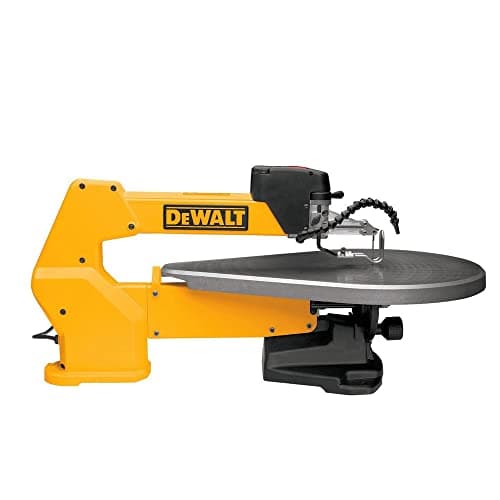
DEWALT DEWALT DW788 20-Inch Variable-Speed Scroll Saw
DEWALT DW788 20-Inch Variable-Speed Scroll Saw

The parallel-link arm is the whole argument. It keeps the blade vertical through the stroke instead of arcing, which is why this saw follows a line in 3/4 in. hardwood that lighter saws wander off.

Best overall
8.4
$551.17Amazon
02
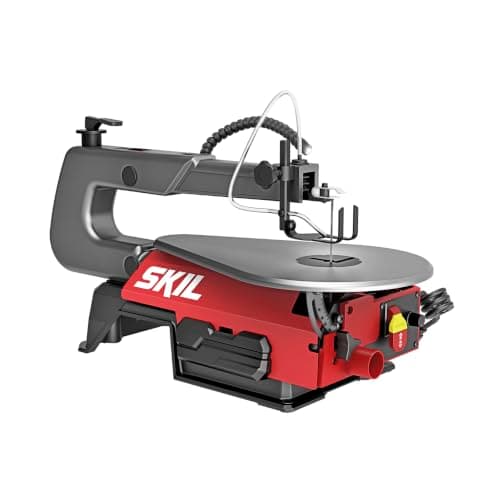
SKIL SKIL SS9503-00 16-Inch Variable-Speed Scroll Saw
SKIL SS9503-00 16-Inch Variable-Speed Scroll Saw

The mid-price 16 in. saw that adds the two things a beginner actually notices: a foot switch, so both hands stay on the work, and a light on the cut line.

Best for a first serious saw
7.4
$199.00Amazon
03
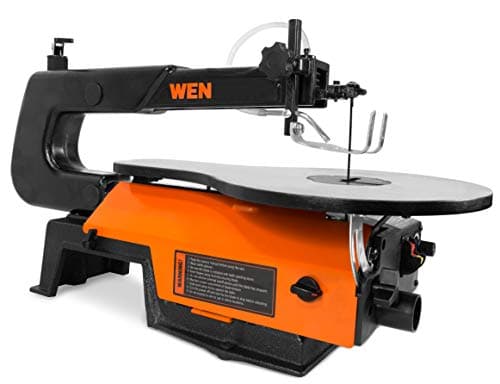
WEN WEN 3922 16-Inch Variable-Speed Scroll Saw
WEN 3922 16-Inch Variable-Speed Scroll Saw

The cheapest saw here that takes pinless blades properly, which is the one feature that decides whether you can cut fine work at all. Everything else it gives up, you can live without.

Best value
7.4
$99.96Amazon
04
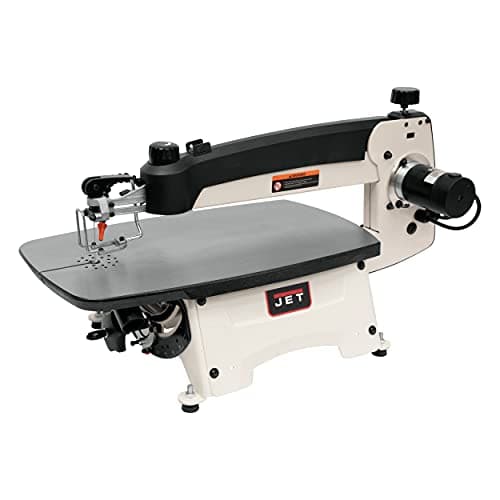
JET JET JWSS-22B 22-Inch Scroll Saw with Foot Switch
JET JWSS-22B 22-Inch Scroll Saw with Foot Switch

Twenty-two inches of throat and a 68 lb cast iron table. This is the saw for work that is too big to turn inside a 16 in. frame — clock faces, large fretwork panels, intarsia.

Best large capacity
8.4
$899.99Amazon
05
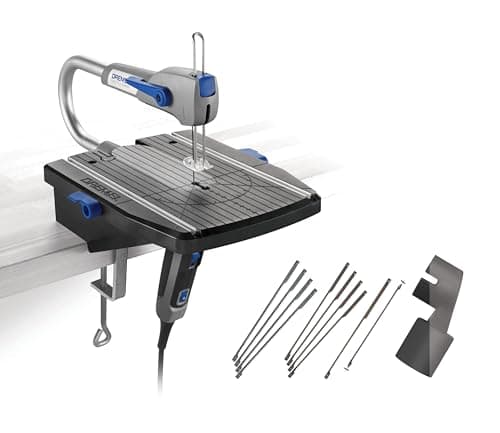
Dremel Dremel MS20-01 Moto-Saw Compact Scroll Saw Kit
Dremel MS20-01 Moto-Saw Compact Scroll Saw Kit

Not a scroll saw in the sense the rest of this page means it — a 2.4 lb powered coping saw that clamps to a bench. For small craft cuts with no room for a machine, that is the honest answer.

Best compact option
6.0
$114.13Amazon

#ad · Live prices from the Amazon Product API, as of Sep 1, 2026. Where we have no verified live price, we show none — we would rather leave a gap than print a number that has rotted.

In detail

The picks, in full

01
DEWALT DEWALT DW788 20-Inch Variable-Speed Scroll Saw

Best overall

DEWALT DW788 20-Inch Variable-Speed Scroll Saw

20 in. throat400-1,750 SPM2 in. depth of cutBevels 45 degrees L and R
8.4/10

The parallel-link arm is the whole argument. It keeps the blade vertical through the stroke instead of arcing, which is why this saw follows a line in 3/4 in. hardwood that lighter saws wander off.

Cut quality
10
Vibration
9
Blade change
8
Capacity
9
Value
6

Pros

  • Parallel-link arm keeps the blade perpendicular through the stroke, so the cut stays square in thick stock
  • Arm lifts and stays up for threading a blade through an interior cut-out
  • 56 lb of cast iron and steel damps the vibration that blurs a fine line

Cons

  • The most expensive saw here by a wide margin over the 16 in. field
  • Tool-free blade clamps still need a knack, and the lower clamp is awkward to reach
  • 56 lb wants a dedicated stand — this is not a saw you lift onto the bench for an hour

Don't buy this if…

you cut a few small ornaments a year. The precision you are paying for shows up in long, detailed work, not occasional cuts.

$551.17View on Amazon

Price as of Sep 1, 2026. Prices change — Amazon's is the one that counts.

#ad · we may earn a commission from this link to DEWALT DW788 20-Inch Variable-Speed Scroll Saw

02
SKIL SKIL SS9503-00 16-Inch Variable-Speed Scroll Saw

Best for a first serious saw

SKIL SS9503-00 16-Inch Variable-Speed Scroll Saw

1.2 A motor16 in. throat550-1,650 SPM16 x 10 in. table, bevels 0-45 degrees left
7.4/10

The mid-price 16 in. saw that adds the two things a beginner actually notices: a foot switch, so both hands stay on the work, and a light on the cut line.

Cut quality
8
Vibration
7
Blade change
8
Capacity
6
Value
8

Pros

  • Foot switch means you start and stop the saw without taking a hand off the workpiece
  • LED work light and a dust blower keep the pencil line visible, which is most of the job
  • Accepts pin-end and plain-end blades, so you are not locked into the coarse pinned sizes

Cons

  • The table tilts left only, so a bevel in the wrong direction means flipping the work
  • Steel table, not cast iron — it damps less and marks more easily than the premium saws
  • Still a 16 in. throat, so a 30 in. panel cannot be turned inside it

Don't buy this if…

your budget stretches to the DEWALT and you plan to use the saw weekly. The gap in cut quality is real and you will find it.

$199.00View on Amazon

Price as of Sep 1, 2026. Prices change — Amazon's is the one that counts.

#ad · we may earn a commission from this link to SKIL SS9503-00 16-Inch Variable-Speed Scroll Saw

03
WEN WEN 3922 16-Inch Variable-Speed Scroll Saw

Best value

WEN 3922 16-Inch Variable-Speed Scroll Saw

16 in. throat550-1,600 SPMCuts up to 2 in. thick16 x 10 in. table, bevels 45 degrees
7.4/10

The cheapest saw here that takes pinless blades properly, which is the one feature that decides whether you can cut fine work at all. Everything else it gives up, you can live without.

Cut quality
7
Vibration
6
Blade change
8
Capacity
6
Value
10

Pros

  • Takes pinned, pinless and spiral blades, so fine fretwork is on the table from day one
  • Side panel flips open for blade changes instead of making you reach under the table
  • Cast iron base for the money is unusual, and it is what keeps the saw on the bench

Cons

  • Vibration is clearly higher than the premium saws, and it gets worse the faster you run it
  • Blade tension is set by feel with no scale to return to
  • The table is small enough that a big panel overhangs and needs supporting

Don't buy this if…

you already know you want to do portrait-grade fretwork. Start further up the page — the vibration will fight you.

$99.96View on Amazon

$124.9920% off

Price as of Sep 1, 2026. Prices change — Amazon's is the one that counts.

#ad · we may earn a commission from this link to WEN 3922 16-Inch Variable-Speed Scroll Saw

04
JET JET JWSS-22B 22-Inch Scroll Saw with Foot Switch

Best large capacity

JET JWSS-22B 22-Inch Scroll Saw with Foot Switch

22-3/8 in. throat400-1,550 SPM2 in. depth of cutArm tilts 45 degrees R / 40 degrees L
8.4/10

Twenty-two inches of throat and a 68 lb cast iron table. This is the saw for work that is too big to turn inside a 16 in. frame — clock faces, large fretwork panels, intarsia.

Cut quality
9
Vibration
9
Blade change
8
Capacity
10
Value
6

Pros

  • The throat depth genuinely changes what you can make, not just how comfortable it is
  • Foot switch is standard equipment rather than an accessory
  • Tilting arm instead of a tilting table keeps the workpiece flat on a bevel cut

Cons

  • The most expensive tool on this page, by a multiple over the 16 in. saws
  • 68 lb assembled — it is a permanent installation, not a saw you move
  • Top speed is lower than the DEWALT, which matters on thin, hard material

Don't buy this if…

your work fits inside a 16 in. throat. You are paying for capacity, and capacity you do not use is just floor space.

$899.99View on Amazon

Price as of Sep 1, 2026. Prices change — Amazon's is the one that counts.

#ad · we may earn a commission from this link to JET JWSS-22B 22-Inch Scroll Saw with Foot Switch

05
Dremel Dremel MS20-01 Moto-Saw Compact Scroll Saw Kit

Best compact option

Dremel MS20-01 Moto-Saw Compact Scroll Saw Kit

0.6 A motor0.315 in. stroke2.4 lbDetaches for handheld use
6.0/10

Not a scroll saw in the sense the rest of this page means it — a 2.4 lb powered coping saw that clamps to a bench. For small craft cuts with no room for a machine, that is the honest answer.

Cut quality
5
Vibration
6
Blade change
9
Capacity
3
Value
7

Pros

  • Clamps to any bench and stores in a drawer, which no real scroll saw does
  • Detaches from the base and becomes a powered coping saw you carry to the work
  • Cuts wood, plastic, laminate and thin metal with the right blade

Cons

  • The stroke is under a third of an inch — cut quality and speed are nowhere near a bench saw
  • Tiny throat and no meaningful table, so anything larger than a hand-sized piece is unsupported
  • Blades are Dremel's own, so you are not shopping the open scroll-saw blade market

Don't buy this if…

you have bench space and $100. The WEN is a real scroll saw for the same money and will not disappoint you in a month.

$114.13View on Amazon

$129.9912% off

Price as of Sep 1, 2026. Prices change — Amazon's is the one that counts.

#ad · we may earn a commission from this link to Dremel MS20-01 Moto-Saw Compact Scroll Saw Kit

Blades matter more than the saw

Pinned versus pinless

A pin-end blade carries a small crosspin at each end that drops into a slot. They are quick to change and almost impossible to fit wrong, which is why budget saws ship with them. The catch is structural: the pin sets a minimum blade width, so pinned blades do not go much below 1/8 in. and they will not pass through a small drilled hole.

A plain-end (pinless) blade is a bare strip of steel clamped at both ends. They come as fine as a thread, they thread through a 1/16 in. entry hole, and every serious fretwork blade made is plain-end. A saw that takes pinned blades only has a hard ceiling on how fine your work can get, and no amount of skill moves it. This is the first thing to check before you buy — every full-size saw on this page clears it.

Spiral blades, and when not to use one

A spiral blade is twisted so its teeth face in every direction, which means it cuts whichever way you push without turning the workpiece. That sounds like a cheat code, and it is genuinely useful when a large panel cannot be rotated inside the throat. The trade is a wider kerf, a rougher edge and much less control over exactly where the line goes. Reach for one when the geometry forces it, not as a default.

Tooth count and the three-teeth rule

The rule that governs every other saw applies here too: at least three teeth should be in the material at all times. In 1/4 in. plywood that means a fine blade, somewhere in the high teens or twenties TPI. In 3/4 in. hardwood a coarser blade clears its own dust and burns less. Running too fine a blade in thick stock is the usual cause of the scorched edges people blame on the saw.

Reverse-tooth blades and the fuzzy underside

A standard scroll saw blade cuts on the down stroke, which pushes the fibers on the bottom face away from the cut and leaves that face furry. A reverse-tooth blade has the lowest inch or so of its teeth pointing back up, so the last teeth through the cut clean up the underside. On anything with two visible faces it is worth the small premium.

Setting the saw up so it actually cuts straight

Tension

An under-tensioned blade bows backward under feed pressure, so the cut wanders and the blade fatigues early. Pluck the tensioned blade with a fingernail: it should give a clear, high note, not a dull thud. If the saw has no tension scale to return to, note the lever position that produces that note and use it as your reference.

Feed pressure

Almost every complaint about a scroll saw wandering comes down to pushing too hard. The blade is a couple of hundredths of an inch of steel; it cannot be steered by force. Let the saw cut at its own rate and use your hands to rotate the work, not to drive it forward. If the cut feels slow, the blade is dull or too fine — it is not asking to be pushed.

Square the table before the first cut

The tilt scale on a new saw is a starting point, not a measurement. Set a small square against the blade and the table, adjust to that, then reset the pointer to zero. If you own a decent woodworking square, this takes two minutes and removes an entire class of mystery errors.

Where a scroll saw fits against the other saws

A bandsaw cuts curves faster, in far thicker stock, and it resaws — but its blade is a welded loop, so it can never start a cut in the middle of a board, and its minimum radius is set by blade width. A jigsaw will make an interior cut-out in a panel too big to lift onto any machine, but its blade is supported at one end only and it is far too coarse for fretwork. The scroll saw covers the gap the other two leave: tight radii, fine detail, and closed shapes cut out of the middle of the work.

It is also the machine most likely to send you looking for two others. Interior cuts need a blade entry hole, which is cleanest at a drill press, and sawn inside curves get cleaned up on an oscillating spindle sander far faster than by hand.

Dust, noise and where to put it

Scroll saws make very fine dust in small quantities, right at face height, which is the worst combination for the fraction you actually breathe. The blower on the saw clears the cut line; it does nothing for the air. A small air filtration unit earns its place in a room where a scroll saw runs for hours, and the volume of chips is low enough that a shop vac at the port is perfectly adequate — this is not a machine that needs a 700 CFM collector.

On noise it is one of the quieter machines in the shop, which is a real advantage: it is the tool you can run in a shared garage on a weeknight without a conversation about it afterwards.

What we could not verify

We have not run these five saws through identical test cuts. Throat depths, stroke rates, stroke lengths, table sizes and weights are the manufacturers' own published figures, linked in Sources below. The reasoning about arm geometry, blade tension and pinned versus plain-end blades is how the machines work, not something we measured.

How we picked

We do not run a testing lab

We researched published manufacturer specifications, manuals and spec sheets, ran the arithmetic those specs support, and read owner reviews at volume, then scored each tool against a published rubric. The scores are judgments from documented research — they are not measurements we took, because we do not have a lab and we are not going to pretend we do. Where a number came from a manufacturer's document, we name it and link it in Sources.

Questions

Frequently asked

What is the difference between a scroll saw and a bandsaw?
A bandsaw blade is a continuous welded loop, so it cuts fast and deep but can only ever enter from the edge of the workpiece. A scroll saw blade is a short straight strip clamped at both ends, so you can unclamp it, thread it through a drilled hole and cut a shape out of the middle of a panel. The bandsaw is the stock-preparation tool; the scroll saw is the detail tool.
Do I need a saw that takes pinless blades?
If you want to do fretwork, yes. Pin-end blades cannot be made much below 1/8 in. wide and will not pass through a small entry hole, so a pinned-only saw caps how fine your work can be. Every full-size saw on this page accepts plain-end blades, which is part of why it is on the page.
How thick can a scroll saw cut?
The full-size saws here are rated by their makers at around 2 in. depth of cut. Treat that as a capacity figure rather than a recommendation — cutting near it is slow, blades wander in the extra depth, and burning is common. Most scroll work happens in stock under 3/4 in. thick, which is where these saws are genuinely good.
Why does my scroll saw blade keep breaking?
Usually tension or feed rate. An under-tensioned blade bows and fatigues at the clamp; too much feed pressure does the same thing faster. Blades are also a consumable — a fine blade in hardwood has a working life measured in minutes, and changing one before it goes dull costs far less than the workpiece a dull blade will ruin.
Is a scroll saw a good first power tool for a beginner?
It is one of the safest and least intimidating machines in the shop — the blade is tiny, the cut is slow, and there is no kickback. But it is a specialist: it makes decorative and detail cuts, not furniture parts. If you are building a first shop for furniture, the beginner tool list puts your first few hundred dollars in better places.

Keep reading

Receipts

Sources

We do not run a testing lab, and we do not pretend to. Our picks come from published manufacturer specifications and manuals, the arithmetic those specs support, and owner reviews read at volume. Where we could not verify something, we say so on the page rather than quietly leaving it out. Read our full method.