A dowel joint has exactly one failure mode: the holes in the two halves do not line up. A doweling jig exists to prevent that, and everything in this ranking is a judgment about how reliably each one does it.
Dowels deserve more attention than they get. A well-fitted dowel joint is strong, completely invisible from every face, and needs no specialist machine — just a drill and a jig. That is a genuinely different proposition from pocket holes, which are faster but leave visible plugs, and from a mortise and tenon, which is stronger but takes far longer to cut.
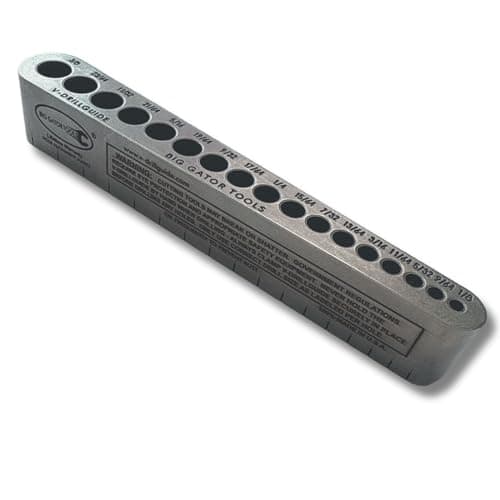
The mechanism worth understanding is self-centring. A self-centring jig clamps around the stock and positions the drill guide at the exact middle of its thickness, whatever that thickness happens to be. This matters because the two halves of a dowel joint are drilled separately — if both are centered on their own thickness, they meet. If either is offset, the joint steps. Every jig here except the Big Gator drill guide works this way; the Big Gator is included as the honest minimalist option, and its limitations are stated on its card.
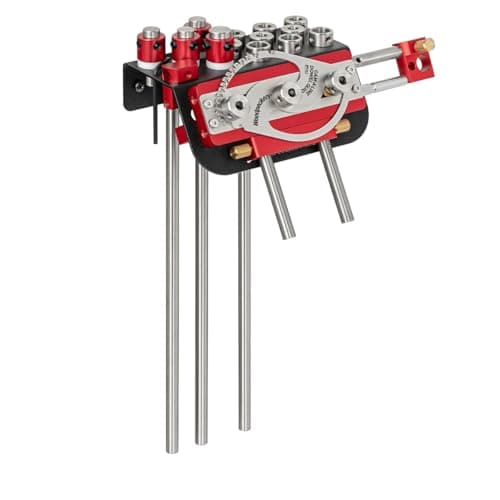
The second thing that decides accuracy is the bushings. A drill bit rubs against the guide bushing every time it passes, and a soft bushing wears oval. Once oval, the bit wanders and the jig is finished. Hardened steel bushings survive; plastic and soft alloy do not, which is why the Woodpeckers leads this list and the plastic-bodied kits sit further down despite doing the same job on day one.
A practical note on dowels themselves: buy fluted dowels, not smooth ones. The flutes give the glue somewhere to go as the dowel is driven, and without them the dowel acts as a piston and either hydraulic-locks or splits the workpiece. Cut the hole about 1/16 inch deeper than half the dowel length in each part, so the dowel never bottoms out and hold the joint open.
How to judge a doweling jig
Bushing material
Hardened steel bushings are the difference between a jig that is still accurate after 500 holes and one that is not. This is the single most reliable predictor of a jig's working life, and it is usually stated in the product description. Some jigs use replaceable bushings, which is the next best thing.
Self-centring mechanism
Look for a jig that clamps the stock and moves both jaws together, so the guide always lands at the middle. Jigs that reference from one face require you to keep the same face against the jig on both halves — which works, but is one more thing to get wrong on the eleventh hole of a long day.
Depth control
The jig positions the hole; something has to control how deep it goes. Better kits include a stop collar for the bit. Cheaper ones expect you to supply one, or to mark the bit with tape — which works but drifts. A drilled-through workpiece is unrecoverable, so this is worth checking before you buy.
Dowel sizing, briefly
Match the dowel diameter to roughly a third to a half of the stock thickness. In 3/4-inch stock, 3/8-inch dowels are the standard choice; 5/16 inch works in thinner material and 1/4 inch is for small parts. Longer dowels are not stronger past a point — the joint fails at the glue line or in the wood around the hole, not in the dowel — so two properly fitted 1-1/2-inch dowels beat one long one.
How many dowels?
Two per joint is the working minimum, because a single dowel lets the joint pivot. Beyond two, more dowels add resistance to racking rather than raw strength. On a cabinet rail, two dowels is standard; on a wide panel edge joint, space them every 6 to 8 inches.
Dowels versus the alternatives
We wrote a whole page on this — pocket holes vs dowels— but the summary is short. Pocket screws are faster, need no glue-up clamping and leave visible holes. Dowels are slower, need clamps and glue, and leave nothing visible. Both are genuinely strong enough for furniture; the choice is about whether the joint will be seen, and whether you would rather spend the time or the clamps.
By budget
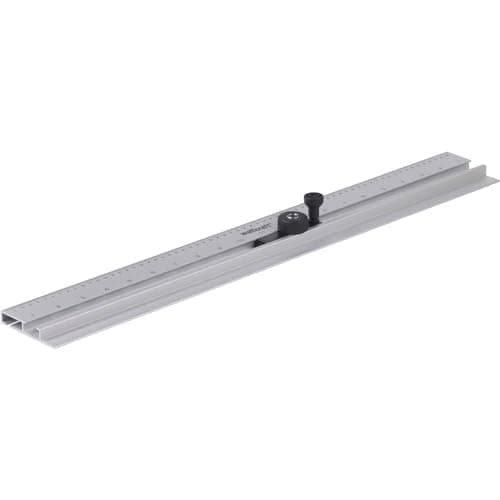
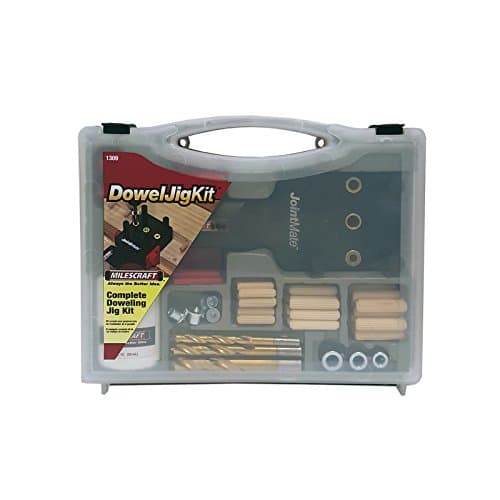
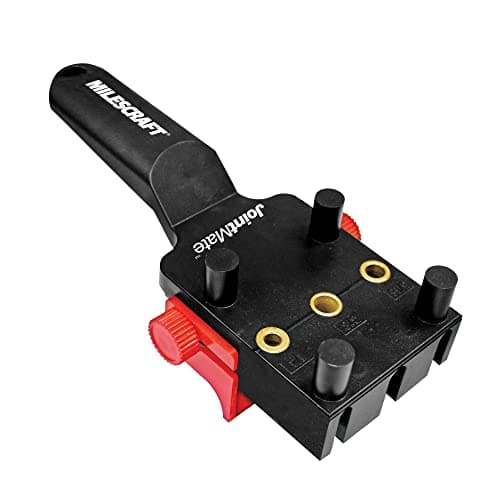
Trying dowel joinery for the first time: the Milescraft 1332 JointMate costs less than a bottle of glue and works. Want the kit complete: the Milescraft 1309 arrives with bits and dowels included. Shelf pins as well as dowels: the wolfcraft, which does both properly. Building furniture you expect to last: the Woodpeckers Cam-A-Line Deluxe kit, which is the one that stays accurate.
What we could not verify
We have not drilled comparative test joints with these five jigs. Bushing sizes, materials and included components above are the manufacturers' published specifications. The bushing-wear argument is a documented mechanical wear mode, not a measurement we took.