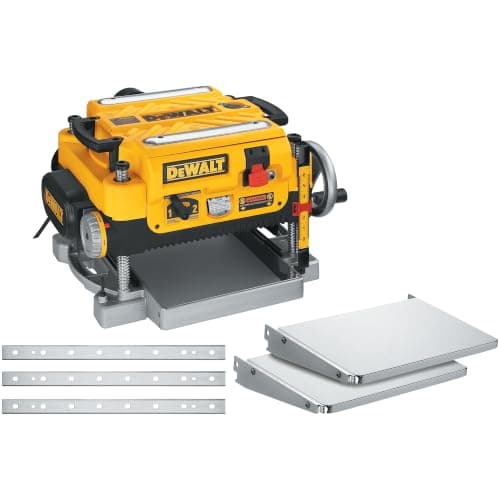
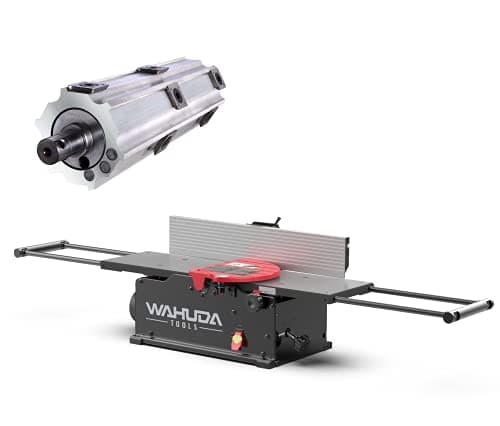
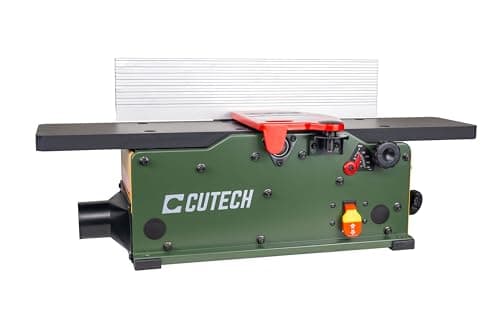
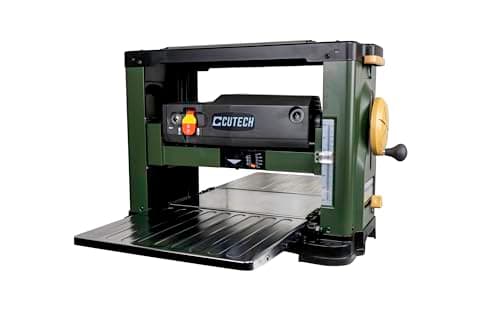
A straight cutterhead carries two or three full-width knives that strike the board along their whole length at once. A helical head carries dozens of small square carbide inserts, arranged in a spiral, so only a few are cutting at any instant and each one enters the wood at a slight shearing angle. Every difference between the two comes out of that.
What actually changes
Tear-out in figured wood
This is the headline, and it is real. A straight knife hitting reversing grain lifts the fibers ahead of the cut and tears a chunk out. A helical insert shears rather than chops, and because it is only about 15 mm wide, any tear-out it does cause is confined to that width instead of running across the whole board. In curly maple, quartersawn white oak or anything with interlocked grain, the difference is not subtle.
In straight-grained poplar, pine or plain cherry, you will struggle to tell the two apart. If your lumber is plain, the upgrade buys you very little in surface quality.
Noise
Straight knives produce a distinctive high-pitched scream because the full width of the knife strikes the wood at once, several thousand times a minute. A helical head staggers those impacts, and the result is a lower, more tolerable sound. It is not quiet — you still need hearing protection — but in an attached garage the difference is worth something to the rest of the household.
Knife changes
Changing straight knives means setting each one to the same height across the head, and doing it wrong leaves ridges in every board afterwards. Some machines have self-setting knives that make this easy; some do not, and it is a genuinely fiddly job.
A helical insert is a square with a screw through the middle. When one edge dulls, you undo the screw, rotate it 90 degrees and retighten — four edges per insert before it is spent. You can also rotate a single damaged insert after a nail strike instead of replacing a whole knife. There is no height setting because the pocket locates the insert for you.
Running cost
More complicated than the marketing suggests. Each insert gives four edges, so a full head lasts a long time, and carbide outlasts high-speed steel by a wide margin. But a full set of replacement inserts is not cheap, and rotating every insert on a wide head is a slow evening with a torque driver rather than a five-minute knife swap.
For a hobby shop, neither cost is likely to matter within a decade. For a shop running the machine daily, the carbide life is the reason the upgrade pays for itself.
Surface finish
Worth being precise about, because it is often overstated. A helical head produces a surface with a fine scalloped pattern from the individual inserts. A well-set straight head produces a surface with regular fine mill marks. Both need sanding before finish; neither leaves a finish-ready surface. What the helical head gives you is a surface with no tear-out to sandout, which is a different and more valuable thing.
Who should buy helical
Yes, if you work with figured or reversing-grain hardwood regularly; if your machine is in an attached garage and noise is a live issue at home; or if you plane enough that knife changes have become a chore you postpone.
No, if you mostly plane construction lumber and plain hardwood; if the machine runs a few times a month; or if the price gap would otherwise buy you a tool you do not yet own. A straight-knife planer plus a random orbital sander handles an enormous amount of furniture work perfectly well.
The retrofit question
Aftermarket helical heads exist for several popular planers and jointers, and they are a genuine option — but price the head plus your time against simply buying a machine that came with one. In most cases the factory-fitted machine works out similar or cheaper once you account for the afternoon spent swapping heads and re-setting the machine.
The other ways to beat tear-out
A helical head is not the only answer, and the free ones are worth trying first.
Read the grain and feed the right way round.Most tear-out is planing against the grain direction. Look at the board's edge, see which way the fibers rise, and feed so the knives cut downhill.
Take lighter passes. A very light final pass removes far less fiber per knife strike and tears out far less.
Slow the feed rate if your machine has two speeds. More cuts per inch means smaller bites.
Finish with a drum sander or a hand plane. Abrasive does not care about grain direction at all, and a sharp smoothing plane with a tight mouth beats any machine on figured stock.
What we could not verify
We have not run identical boards through both head types and compared the surfaces. Insert counts, knife counts and machine capacities come from the manufacturers' current listings; the explanation of shearing angles, impact staggering and tear-out is how the cutterheads work rather than a measurement we took.