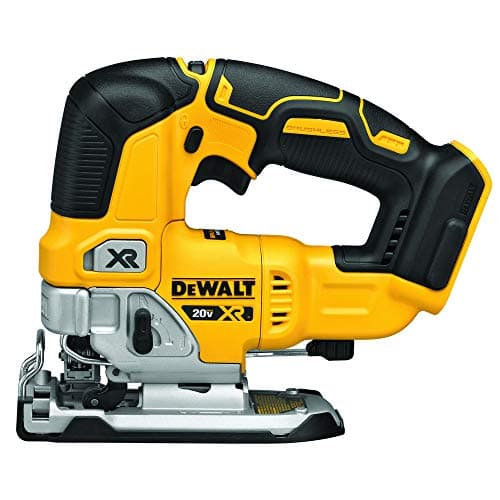
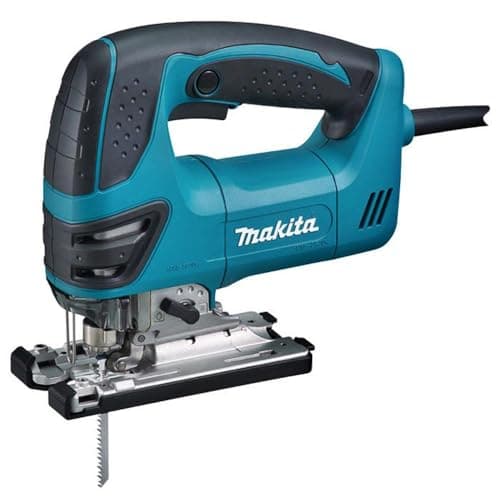
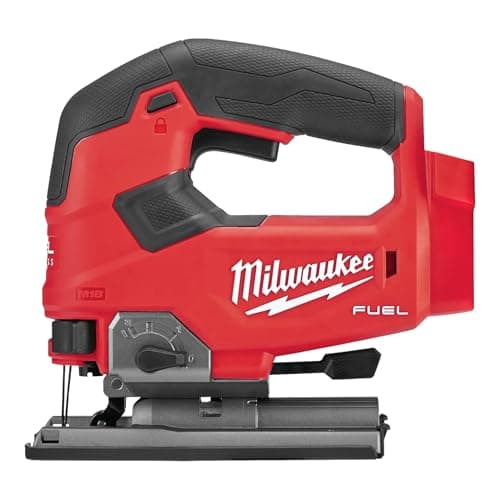
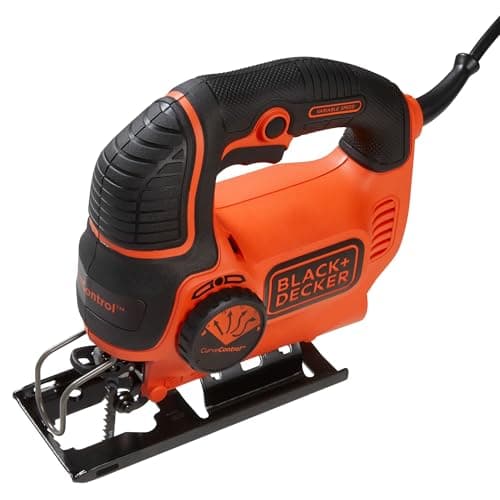
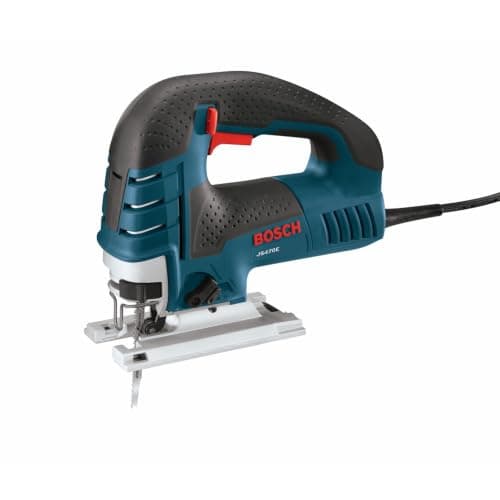
A jigsaw is the only power tool that cuts a curve in a wide board, which makes it irreplaceable — and it is also the tool most likely to produce an out-of-square edge, which makes it frustrating. Both facts have the same cause: the blade is supported at one end only and is free to deflect along its length.
That is why blade support is the single most important thing separating these saws. A good jigsaw carries a roller guide close behind the blade that resists sideways deflection. A cheap one lets the blade lean, so the top of the cut follows your line and the bottom does not — the classic beveled edge that ruins a curve in thick stock.
The second decision is grip. A top-handle saw puts your hand above the tool, which is comfortable and familiar. A barrel grip puts your hand around the body, level with the blade, which gives noticeably better feel for where the blade is going. For following a pencil line in furniture work, a barrel grip is the better tool; for overhead and awkward cuts, a top handle is easier to hold.
And then there is the part nobody wants to hear: the blade matters more than the saw. A premium jigsaw with a worn, wrong-tooth-count blade cuts worse than a budget saw with a fresh one. We come back to that below, because it is the cheapest upgrade available on this page.
Blades: the upgrade that costs almost nothing
Up-cut versus down-cut
A standard jigsaw blade cuts on the up stroke, which pulls the teeth toward the top face of the board and tears out the veneer there. If the good face is up — which it usually is, because that is the face you are following the line on — you want a down-cut (reverse-tooth) blade, which cuts on the down stroke and leaves the top face clean. This single swap solves most jigsaw tear-out complaints.
Tooth count and stock thickness
Fewer, larger teeth cut faster and rougher; more, smaller teeth cut slower and cleaner. The rule that matters is that at least three teeth must be in contact with the material at all times. In 3/4 in. hardwood a 10 TPI blade is a sensible default; in thin ply go finer, in 2 in. softwood go coarser.
Orbital action: off for curves, on for speed
Orbital action swings the blade forward on the cutting stroke, which removes material far faster and roughens the edge considerably. Turn it off entirely for curves and any cut you intend to keep; turn it up for rough breakdown where speed is the point.
Where a jigsaw fits against the other saws
The jigsaw's job is the interior cut-out and the free curve — a sink opening, a cabinet back cut-out, a curved apron, a template blank. It is not a straight-line saw. If you are cutting a straight line in a sheet, a track saw does it better and squarer. If you are cutting a tight curve in thick stock, a bandsawdoes it better still, because its blade is supported at both ends. And if the curve is fine detail rather than a shape — fretwork, an inlay, a pierced panel — a scroll saw is the machine for it.
The jigsaw's unique advantage is that it is the only one of the three that will cut a hole in the middle of a board you cannot lift onto a machine. That is worth owning for on its own.
Corded or cordless?
A jigsaw is used in short bursts, often away from the bench, and it is one of the tools where going cordless changes how often you reach for it. If you already own batteries on a platform, buy into it. If you do not, a corded saw gives you more power for less money and never needs charging — the two premium corded saws here are the better value by a clear margin.
What we could not verify
We have not run these saws through identical test cuts. Motor ratings, stroke rates and bevel capacity come from the manufacturers' current listings; the reasoning about blade deflection, tooth direction and orbital action is how the tool works, not something we measured.