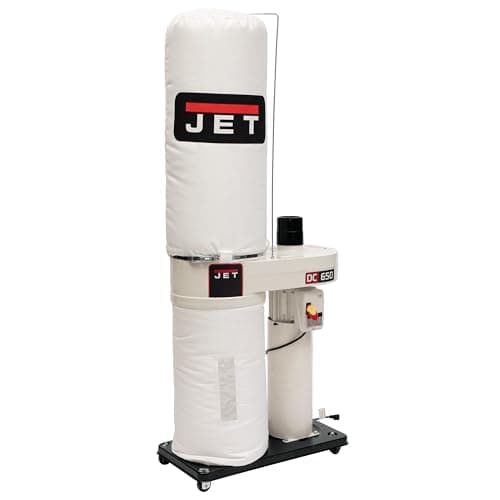
The CFM number on a dust collector's box is a free-air rating — measured with nothing attached to the inlet. Bolt on a flex hose, a couple of fittings and a filter, and the flow that actually reaches your tool can be less than half of it. So the honest way to rank collectors is by what they deliver at the machine, not by the sticker. That is the arithmetic nobody publishes, and it is how we ranked these five.
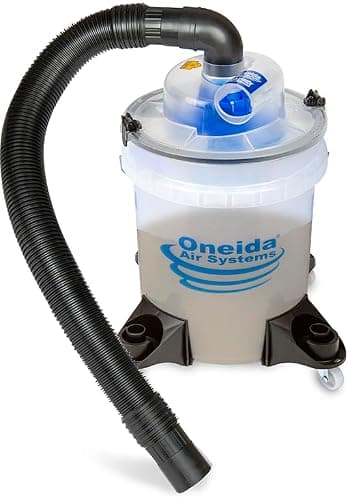
Start with the job, not the horsepower. For handheld sanders and a track saw — low volumes of fine dust from small ports — a shop vac paired with a cyclone separator like the Oneida Dust Deputy is the right first step, and a full collector is overkill. The moment you add a machine that throws real chips — a benchtop thickness planer, a jointer or a table saw — a shop vac chokes, and a dedicated single-stage collector becomes the step up.
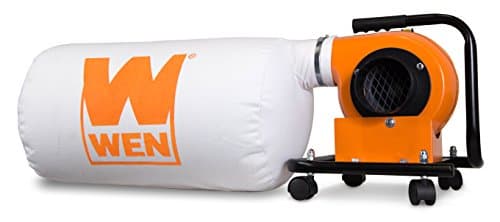
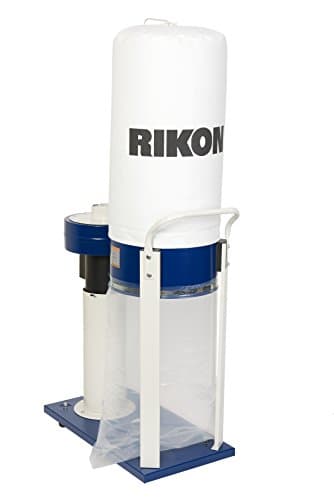
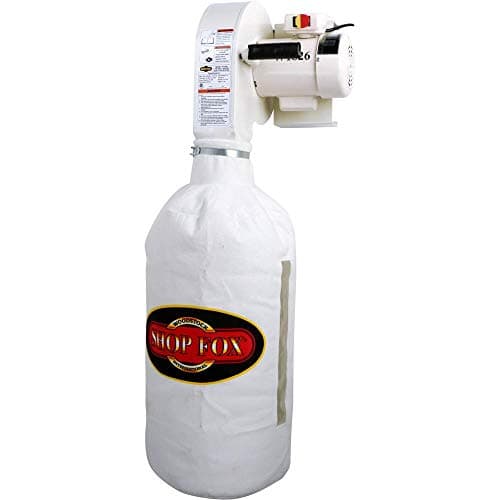
That is how the field lines up. The JET DC-650 is the sensible first dedicated collector: 650 CFM at a 4-inch inlet, and the useful trick of running on an ordinary 115V outlet. The WEN DC3401 is the cheapest unit that still outmuscles a vac. The Rikon 60-100 is a tidy 1 HP portable that splits the difference. The wall-mounted Shop Fox W1826 buys back floor space in a cramped garage. And the Oneida Dust Deputy is not a collector at all — it is the cyclone that turns the shop vac you already own into a far better dust-capture setup.
One thing a collector is not: air filtration. An ambient air filter clears the ultra-fine dust that stays airborne after you cut, and it is a genuine health upgrade — but it is an addition to collection at the tool, never a replacement for it. Capture the chips at the source first; filter the haze that escapes second.
How much CFM do you actually need?
Here is the reasoning laid out so you can reproduce it. A single small-shop machine wants roughly 350–700 CFM measured at the tool port: a benchtop planer or a table sawsits near the lower end, while a wider machine or one with a big open hood pushes toward the top. That is the target — flow at the tool, not flow at the blower.
Now the catch. Manufacturers rate a collector in free air: the impeller spins with nothing on the inlet, so there is almost nothing for it to fight. The WEN DC3401 is published at 660 CFM free air; the Rikon 60-100 near 650; the wall-mount Shop Fox W1826 near 537. JET quotes the DC-650 more usefully — 650 CFM at the 4-inch inlet, plus 6-1/2 in. WC of static pressure — because that is closer to what a real duct sees. All of them are ceilings, not deliveries. Every foot of hose, every fitting and the filter itself add static pressure, and static pressure eats airflow.
Where the airflow goes
Three things cost you the most. Hose length— a long run has more resistance than a short one. Hose diameter— dropping from a 4-inch port to a smaller one throttles flow sharply, because resistance climbs fast as the pipe narrows. And ribbed flex hose and fittings— corrugated flex has far more drag than smooth pipe, and every 90-degree elbow or reducer is another loss. Stack a long, narrow, kinked flex run with two elbows onto a unit and delivered flow at the tool can fall below half the free-air number.
Turning that into a buy
So the method is: take your machine's need (say 350–700 CFM at the port), then pick a collector whose free-air rating has enough headroom to survive the losses in your ducting. Keep the run short, keep it 4 inches or wider, favor smooth pipe over long ribbed flex, and use as few elbows as you can. A 1 HP unit like the JET DC-650 or the Rikon 60-100 has the headroom for one machine at a time in a small shop; the smaller WEN works best on the closest machine with the shortest hose. If you plan to duct several tools permanently, size up, because every added foot and fitting is spending airflow you cannot get back.
Filtration is a separate job
None of this is about the fine dust that hangs in the air — the particles small enough to stay airborne and reach your lungs. Collection at the tool grabs chips and coarse dust; an ambient air filter handles the haze that escapes. They solve different problems, and a shop that cares about its air wants both, in that order.
How we picked
We do not run a testing lab
We researched published manufacturer specifications, manuals and spec sheets, ran the arithmetic those specs support, and read owner reviews at volume, then scored each tool against a published rubric. The scores are judgments from documented research — they are not measurements we took, because we do not have a lab and we are not going to pretend we do. Where a number came from a manufacturer's document, we name it and link it in Sources.