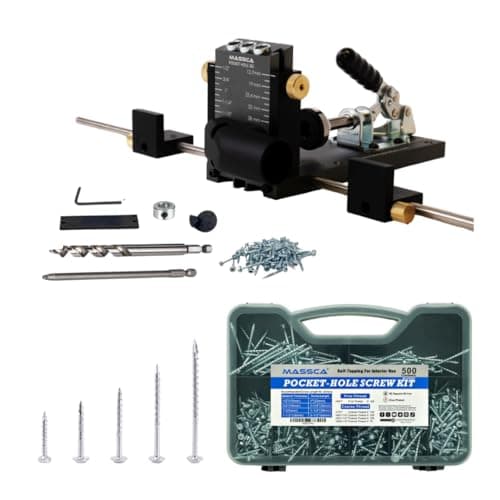
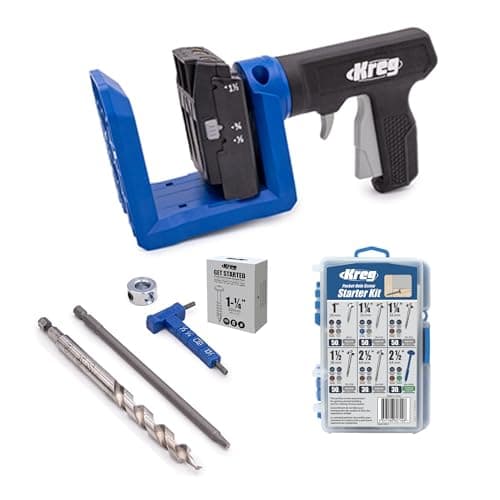
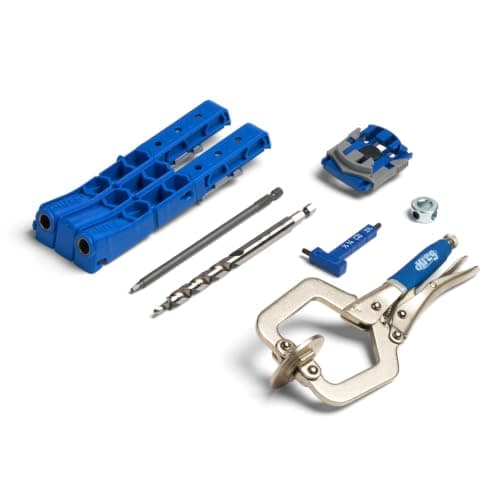
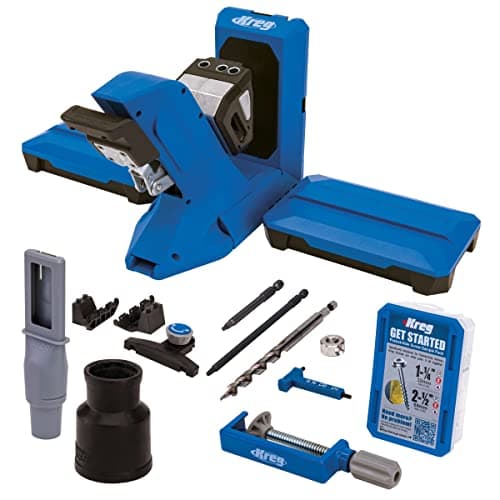
Both jigs drill the same hole. Pocket-hole geometry is not proprietary — it is a 15-degree bore with a stepped drill, and any jig that holds those two things accurately produces a joint of the same strength. So the comparison is not about the joint. It is about clamping, wear, consumables and what happens on the two-hundredth hole.
Kreg is the company that popularized the method, and the practical consequence is ecosystem. Its jigs, clamps, screws, plugs and accessories are designed together and stocked everywhere, which matters when you need a specific screw length on a Sunday. The top jigs also integrate clamping into the tool itself, so one lever action clamps the workpiece and sets the depth stop.
Massca competes on price and materials. Its two-hole jigs use hardened steel guides in an aluminum body and cost meaningfully less than the comparable Kreg. The clamping is generally external — you supply a clamp — which is slower per hole and entirely adequate if your holes come in small batches.
The decision in one paragraph: if you are drilling a lot of holes in a session — cabinets, face frames, a run of shop furniture — buy the jig with integrated clamping, because the seconds per hole compound. If you drill pocket holes occasionally, the cheaper jig does an identical job and the money is better spent on screws and clamps.
Head to head
Clamping
Kreg, on the top jigs.The integrated clamp is the single biggest workflow difference here: one lever clamps the stock, sets the guide against it, and releases. With an external clamp you position the jig, clamp it, drill, unclamp, reposition. On six holes that is nothing. On a kitchen's worth of face frames it is an hour.
Guide wear
Close, and both are fine.Both use hardened steel guides, which is what matters — an unhardened guide wears oval and the hole angle drifts. Neither of these will wear out in a home shop's lifetime. Where they differ is replaceability: check whether the guides on your chosen jig can be replaced at all, because on some designs they cannot.
Setup and stock thickness
Kreg, marginally. The premium Kreg jigs set drill depth and guide position from a single thickness scale, so switching from 3/4 in. to 1/2 in. stock is one adjustment. Most competing jigs need the collar and the jig set separately, which is one more step to get wrong. It is a small difference that shows up as fewer blown-out workpieces.
Screws and consumables
Genuinely interchangeable. Pocket-hole screws are not proprietary to a jig — any correctly sized pocket-hole screwworks in any jig's holes. What matters is coarse thread for softwood and plywood, fine thread for hardwood, and the right length for your stock. Buy screws on quality, not on brand matching.
Cost over time
Depends entirely on volume. The cheaper jig wins on day one. The jig with integrated clamping wins if you are drilling regularly, because the time saved is worth more than the price gap within a couple of projects. If you cannot predict your volume, start cheap — the upgrade path costs you the price of the first jig and nothing else.
What neither jig fixes
Blowout on thin stock. A pocket hole in 1/2 in. material leaves very little meat above the bore. Set the depth carefully and test on offcuts.
Visible holes. Both leave the same oval hole. Plugs help on painted work and never quite disappear on stained hardwood — which is the argument our pocket holes versus dowels comparison works through.
Racking. A pocket-hole joint depends on two fasteners, so it resists racking less well than a glued area joint. For a chair or anything that will be pushed sideways for decades, that is mortise-and-tenon territory.
What we could not verify
We have not run destructive tests on joints made with each jig, and we would not expect a difference if we did — the hole geometry is the same. Guide materials, capacities and clamping mechanisms are taken from the manufacturers' current listings.