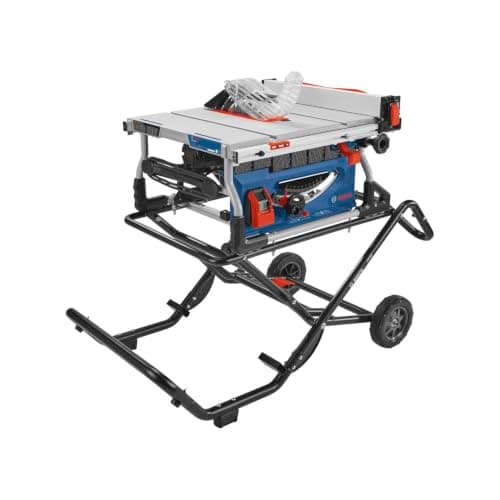
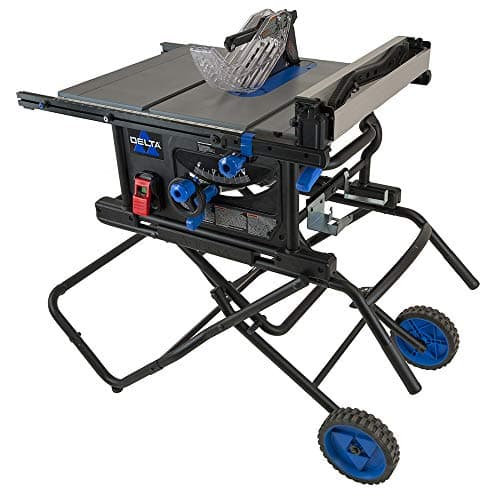
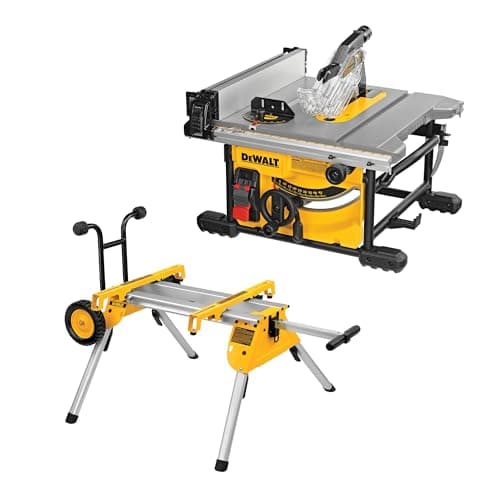
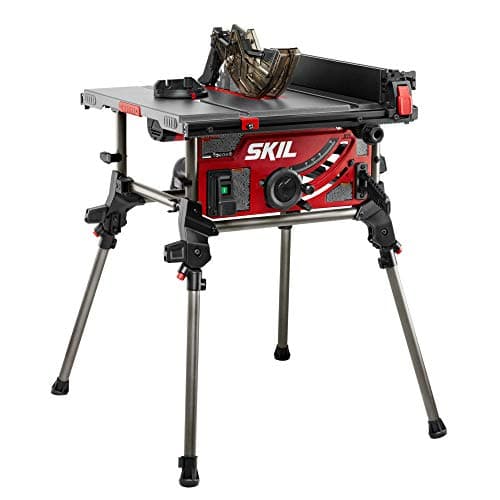
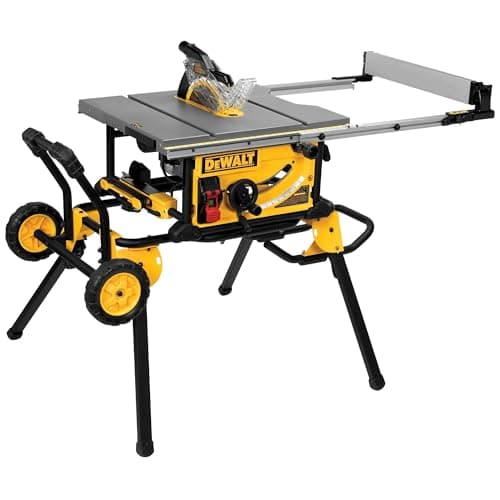
Buy the DEWALT DWE7491RS. Under $1,000 the fence decides everything, and the DWE7491RS has the best one in this bracket: a rack-and-pinion mechanism that moves both ends of the fence together so it cannot rack out of parallel, over a published 32-1/2 in. of rip to the right of the blade, on a rolling stand that one person can move alone. The budget pick is the SKIL TS6307, the cheapest saw here that still has a 10 in. blade, a 15 A motor and a usable fence. The Bosch GTS15-10 is the pick for a shared garage because of its Gravity-Rise stand, the Delta 36-6023 for a saw that will live in one spot, and the DEWALT DWE7485 if the saw has to fit in a car.
Every price on this page comes from our live price layer rather than from this article, and all five saws sat under the $1,000 cap at the last price check on November 21, 2026. Amazon moves prices daily; the number beside each pick in the table is the current one, and if a saw has crossed the cap since, the table will show it rather than hide it.
What $1,000 does and does not buy
There are three families of table saw, and the cap lands squarely inside one of them.
Jobsite and portable saws — all five here — use a universal motor driving the arbor directly, an aluminum or composite table, and a stand that folds or rolls. They are loud, they weigh under a hundred pounds, and they are the only kind you can move. The good ones have genuinely excellent fences, which is the single thing that has improved most in this category over the last decade.
Contractor saws hang an induction motor off the back of a larger cast-iron table. Quieter, heavier, mostly discontinued as a category, and usually found secondhand.
Cabinet saws put a 3 to 5 HP induction motor inside an enclosed base under a full cast-iron top. They are a different tool: quieter, far heavier, dramatically better at dust collection, and they start at several times this cap. If a cabinet saw is what you want, do not buy a $990 jobsite saw as a stepping stone — save, and look at the full table saw roundup, which ranks the category without a price cap.
The fence is the saw
On a saw in this bracket, the motor is close to irrelevant — all five here are 15 A, which is the ceiling of a standard North American circuit. The table is thin on all of them. The miter slots are fine on all of them. What actually separates a saw you can build furniture on from a saw that frustrates you is whether the fence lands parallel to the blade, every single time, without being fussed with.
A cheap fence locks at the front rail only, which lets the far end swing. A degree of swing at the back of the fence is a cut that pinches the blade, which burns the edge at best and throws the offcut at worst. The fix is a fence that is driven at both ends: rack and pinion gearing, which is what the DEWALT saws here use, moves the front and the rear rails in lockstep so the fence physically cannot go out of parallel as it travels.
Test any table saw fence the same way, new or used. Set it beside the miter slot, measure the gap at the front of the slot and again at the back, and slide it along the rail repeating that check. If the two numbers stay equal everywhere, the fence is good. If they diverge and keep diverging in the same direction, the rail needs adjusting. If they diverge unpredictably, the fence is the problem and no adjustment fixes it.
Rip capacity is the second number
Rip capacity is the distance from the blade to the fence at full extension, and it decides one specific thing: whether you can cut a full sheet of plywood in half with the good edge against the fence. A 4 ft sheet halved is 24 in., so a saw with less than about 25 in. to the right of the blade cannot do it in one pass with the offcut supported properly.
The DEWALT DWE7491RS and the Delta 36-6023 both publish 32-1/2 in., and the Bosch publishes 32-1/8 in. — all three comfortably past a half sheet, which is what the large rails are for. The SKIL publishes 25-1/2 in. and the compact DEWALT DWE7485 publishes 24-1/2 in., which is right at the line.
Be honest about whether you need it. A shop that mostly breaks sheet goods down should buy a track saw and a modest table saw rather than a big table saw and no track saw: wrestling a full sheet across any portable saw alone is the most genuinely dangerous thing most hobbyists do.
The stand is not an accessory
Three different stand philosophies are represented here and the right one depends entirely on your floor.
Rolling stand (DWE7491RS): big wheels, a handle, and it tips up and rolls like a hand truck. Best if the saw lives in a corner and comes out for work.
Gravity-Rise (Bosch GTS15-10): the stand unfolds and locks as you tip the saw down, so setup and teardown are a single movement. Best in a shared garage where the car comes back every evening.
Fixed or folding legs (Delta, SKIL): lighter, cheaper, and fine if the saw stays put.
The compact DEWALT DWE7485 has no stand in the box at all, which is the trade for being the one that fits in a hatchback.
What the cap costs you: dust
The honest weakness of every saw on this page is dust collection. An open-base jobsite saw throws a large fraction of its dust out of the bottom of the cabinet and off the back of the blade, and the 2-1/2 in. port behind it captures what reaches it and no more. This is not a defect in any one model; it is the category.
Two things help and neither is expensive. A shop vac on the port catches the airborne fraction at the blade — our shop vacs under $200 page is sized for exactly this job. An over-blade guard with its own hose catches most of the rest, and is the single biggest improvement available to a portable saw. The full picture, with the airflow arithmetic, is on table saw dust collection.
Side by side
| Saw | Blade | Published rip capacity | Motor | Stand |
|---|
| DEWALT DWE7491RS | 10 in. | 32-1/2 in. | 15 A | Rolling stand |
| Bosch GTS15-10 | 10 in. | 32-1/8 in. | 15 A | Gravity-Rise |
| Delta 36-6023 | 10 in. | 32-1/2 in. | 15 A | Stand included |
| DEWALT DWE7485 | 8-1/4 in. | 24-1/2 in. | 15 A | None (compact) |
| SKIL TS6307 | 10 in. | 25-1/2 in. | 15 A | Foldable stand |
Every figure is the manufacturer's published specification for the exact listing we link. We did not measure a rip capacity or time a cut; there is no lab here, and the methodology page states that plainly.
Buy the blade too
Whatever you spend under this cap, the stock blade is the weakest part of the saw. A 40- or 50-tooth combination blade transforms how any of these cut, costs a small fraction of the saw, and is the first thing to buy afterwards — ahead of a dado set, ahead of a miter gauge, ahead of anything. The field is ranked on best table saw blade.
What to buy, in order
One saw for a garage shop that builds furniture: the DWE7491RS, plus a good blade. Shared garage where the car returns nightly: the Bosch GTS15-10 for the stand. Saw that stays in one place and the money matters: the Delta 36-6023. Saw that travels in a car: the DWE7485. Tightest budget that still gets a real 10 in. saw: the SKIL TS6307.