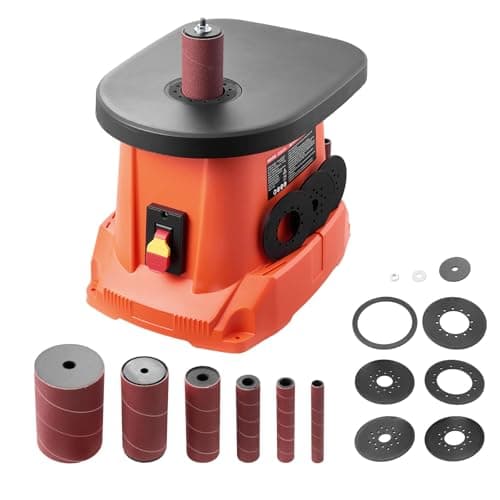
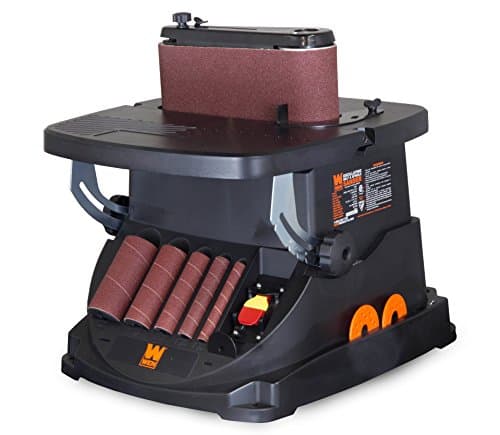
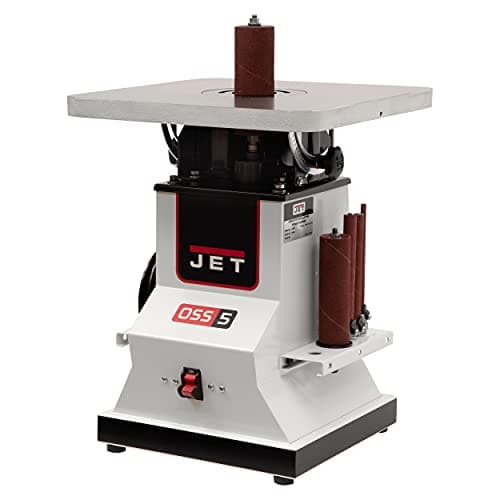
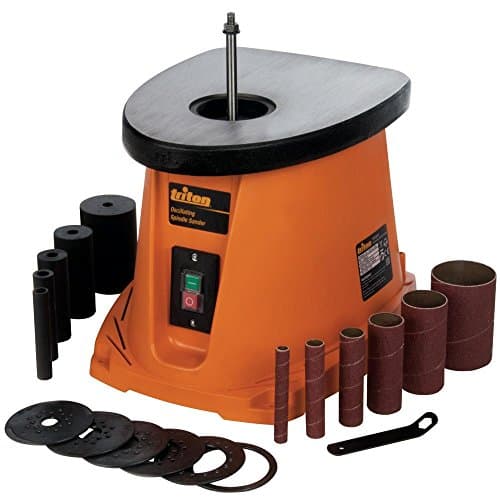
Sanding an inside curve by hand is the most tedious job in woodworking, and a spindle sander eliminates it almost entirely. A drum spins in the table; you feed the workpiece against it and the curve comes true in seconds. The word that matters is oscillating: the drum also moves up and down as it spins, which spreads the wear across the whole abrasive sleeve rather than glazing one band of it.
That oscillation is not a luxury feature. A non-oscillating drum wears a groove in one place, loads up, stops cutting and starts burning, and it leaves a visible band across the workpiece. Every machine worth buying oscillates, which is why this ranking does not include the drum attachments that fit a drill press — they do not.
The other decisions are simpler. Table size and material: a cast-iron top stays flat and damps vibration, a stamped steel one is lighter and cheaper. Spindle range: the machine ships with several drum diameters, and the smallest one determines the tightest inside curve you can sand. Dust collection: sanding produces the finest, most lung-reaching dust in the shop, and a spindle sander with a proper port under the table connected to a shop vac collects a genuinely large proportion of it.
One honest caveat before you buy: a spindle sander only earns its bench space if you cut curves. If your work is rectilinear casework, a random orbital sander does far more for you. If you make anything with a template, a shaped leg or a curved apron, this machine will save you hours.
How to choose a spindle sander
Table: cast iron or steel
A cast-iron table is heavier, flatter and quieter, and it damps the vibration that makes a light machine walk across the bench. A stamped steel table is lighter to move and cheaper to buy. If the sander will live permanently on a bench, take the cast iron; if it comes out of a cupboard for one project a year, the weight is a real cost.
Spindle sizes and inserts
Machines ship with a range of drums, typically from about a quarter inch up to two inches, with matching table inserts so the gap around the spindle stays small. The small spindles do the tight inside curves; the big ones do gentle sweeps and, being larger, cut faster and leave a flatter surface. Check that inserts are included for every spindle — a mismatched insert leaves a gap that catches small workpieces.
Oscillation stroke and speed
More oscillation spreads wear over more of the sleeve, which means longer sleeve life and less chance of burning. Manufacturers publish strokes per minute and stroke length; both are useful comparative figures, though in practice every oscillating machine is dramatically better than none.
Dust collection is the weak point
Almost every benchtop sander in this class has a modest port under the table. Connected to a shop vac it does a decent job; left unconnected it fills the table with dust that gets between the work and the drum and scratches. Plan to connect it every time — and if the port size does not match your hose, our hose and fittings roundup covers the adapters.
Getting good results
Three habits. Feed against the rotation so the drum pushes the work into your hands rather than pulling it away. Keep the work moving— pausing in one spot is exactly how you get a flat on a curve. And use the whole spindle height rather than the same band, which extends sleeve life considerably.
Bandsaw first, sand second. A spindle sander is a refining tool, not a shaping one: cut close to the line on the bandsaw and let the sander take the last millimeter. Trying to remove a lot of material burns sleeves and rounds the edge over.
Segmenting by shop and budget
Occasional curves: the cheapest oscillating machine you can find. Even a light one is transformative compared with sanding by hand, and it will not be the limiting factor on a few projects a year.
Regular curved work: a cast-iron-topped machine. Flatter table, less vibration, better results on parts where the edge is visible.
No spare bench space: a belt-and-spindle combination, or a drill press that oscillates. Two functions on one footprint is the trade a small shop is usually happy to make.
Daily use: a heavier induction-class machine that will not slow when you lean into a hardwood curve, and whose spindles and parts are still available in a decade.
How we ranked these
From published manufacturer specifications (motor rating, table material and size, spindle sizes supplied, oscillation figures, dust port size), the manuals, and the pattern in owner feedback read at volume. We have not measured sanding rate, table flatness or dust capture — we do not run a lab, per our methodology page. Prices come from the live feed.