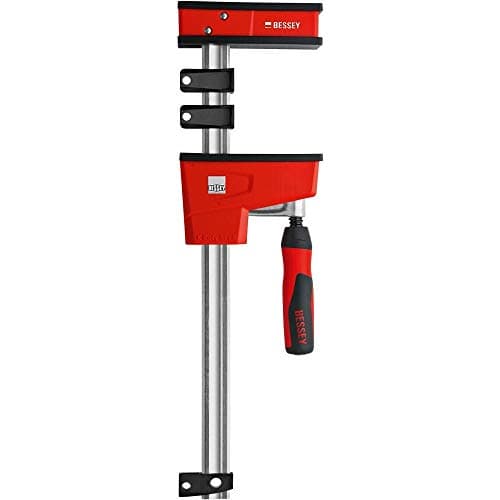
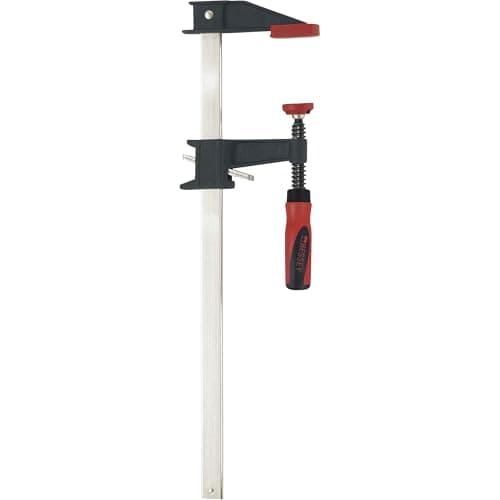
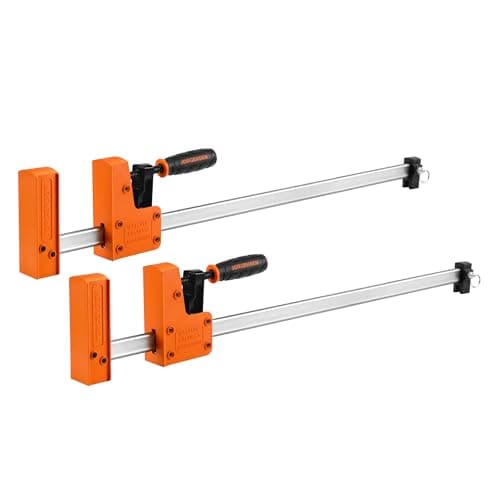
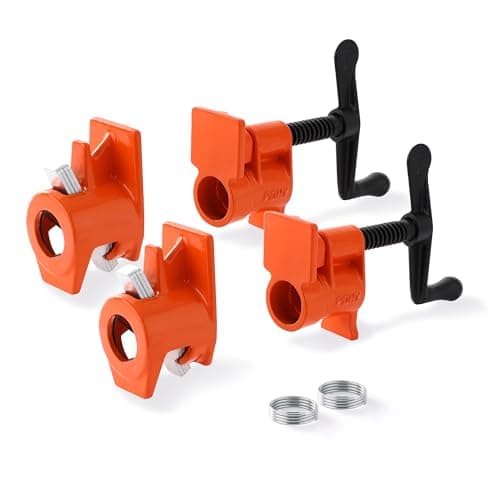
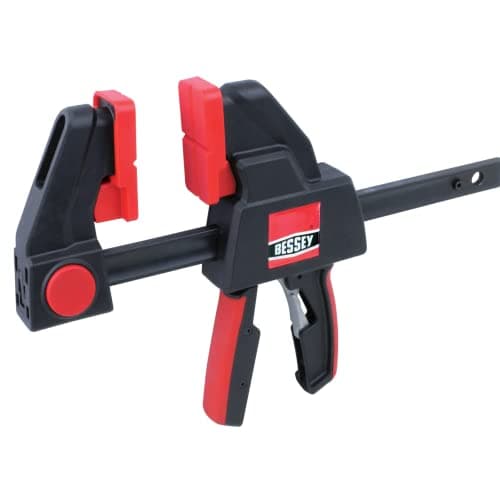
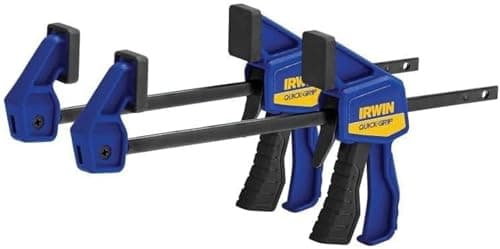
"You can never have too many clamps" is genuinely true — but the smarter move is to buy fewer, better clamps of the right type than a drawer full of the same one. Parallel clamps like the Bessey REVO are what flatten a panel glue-up; one-handed trigger clamps like the Irwin Quick-Grip are for holding parts while your other hand works; pipe clamps are the cheapest way to reach across a wide project. Match the clamp to the job and a handful does the work of a pile. We ranked these by what they're actually for, and flagged where each earns its place.
Clamps split cleanly by task. For flat panel glue-ups — edge-joining boards into a tabletop or a cabinet side — you want parallel-jaw clamps, because their wide jaws stay square to the work and press it flat instead of bowing it. For holding— a part while you drill it, a jig while you rout, an assembly while the glue grabs — nothing beats a one-handed trigger clamp you can set with the hand that isn't busy. For long, cheap reach, pipe-clamp fixtures let you buy a length of pipe and clamp anything as wide as your project. A general-duty bar clamp fills in everywhere else.
So the honest starter kit isn't "a dozen of the cheapest clamp." It's a few parallel clamps for real glue-ups, several one-handed triggers for holding and assembly, and a pair of pipe fixtures for when a project outgrows everything else. Buy the types the work demands and add depth over time. When those glued-up panels become boxes and drawers, our dovetail jig roundup covers the joinery side.
How to choose woodworking clamps
Buy for the job, not by the count. The mistake most beginners make is grabbing a big handful of one cheap clamp, then discovering it can't press a panel flat or reach across a tabletop. A better first spend spreads across types: parallel clamps for glue-ups, one-handed triggers for holding, and pipe fixtures for long reach. Three types that each do their job beat a dozen clamps that all do the same one.
Parallel vs bar vs trigger vs pipe
Parallel clamps have wide jaws that stay perpendicular to the bar, so panels come out flat rather than bowed, and they put down serious, even pressure — the Bessey REVO and the value-priced Jorgensen are the glue-up tools here. Bar clamps like the Bessey clutch are the general-duty workhorse: strong, affordable, quick to build a set of. Trigger clampstrade clamping force for one-handed convenience, which is exactly what you want when you're holding parts together during assembly. Pipe clamps give you the cheapest long reach going — you supply the pipe, so capacity is limited only by how long a length you buy.
The trade-off: force vs convenience vs cost
No single clamp wins on all three. Parallel clamps deliver the most controlled force but cost the most, so you buy a few, not a dozen. Trigger clamps are the easiest and cheapest to own in quantity but their force is modest — fine for holding, not for closing a stubborn panel. Pipe clamps are the cheapest route to real capacity but are a step slower to set up. Decide which of the three you need most for the work in front of you, and buy that type first.
Practical tip: protect the wood, don't over-tighten
Bare metal and hard resin jaws can dent or stain soft wood, so keep a stack of scrap cauls to pad the jaws — cheap insurance against a mark you'll sand for an hour. And more pressure isn't always better: over-tightening a non-parallel clamp can twist a thin panel or squeeze out all the glue and starve the joint. Snug and square beats cranked-down hard. Pair your clamps with sharp chisels for cleaning up the joints before glue-up, and see where clamps fit a first shop in our essential woodworking tools guide.
How we picked
We do not run a testing lab
We researched published manufacturer specifications, manuals and spec sheets, ran the arithmetic those specs support, and read owner reviews at volume, then scored each tool against a published rubric. The scores are judgments from documented research — they are not measurements we took, because we do not have a lab and we are not going to pretend we do. Where a number came from a manufacturer's document, we name it and link it in Sources.